February 26, 2011

Cabot wines of California's Humboldt county

Growing up in Los Angeles, Humboldt county in far northern California always had an appeal. Remote. Forested. Some said there were legendary if cold waves to surf. And of course, there was weed. Pot. Ganja. Call it what you will, but the world knows Humboldt for its marijuana.

I imagine John and Kimberley Cabot might get annoyed if everyone mentions pot when talking or writing about their wines. I'm not helping. Or maybe they don't care. It's just that Humboldt isn't known for wine. Humboldt embodies rugged, and the Cabot's own labels feature a topographical map with a clear "X" marking their location. Seemingly in the middle of nowhere.

Probably surrounded by pot farms. Ok, enough already.

So you're forgiven if you've never had Humboldt county...wines. I never had until last weekend, when Michael Alberty of Storyteller Wines locally invited some people down to the shop to taste through a selection of Cabot Vineyards bottlings, which are only recently available in this market.

I'll spare the details of a shipping mistake that left us with wines intended for a tasting in New York City. We still have a variety of things to try and I was impressed, and interested to try more from this clearly below the radar (for the moment) producer.

A quick look at the Cabot web site makes it clear that John and Kimberly are committed to organic viticulture and hands-off wine making. That shows in the wines, which reminded me a bit of Edmunds St. John, one of my favorite California producers that make wines accentuating the unique fruit of California with an energy and cut you typically find only in the old world.

We started by trying two vintages of the Klamath Cuvee Red Table Wine. The 2005 was my preference, showing more syrah character than anything else (60% syrah, the rest cabernet, zinfandel and merlot). Dark fruit, white pepper, beef and iron aromas, with a lovely texture, floral blackberry flavors, good length, acidity and grippy tannin, just love this. The 2006 is 60% syrah but 40% cabenert sauvignon, and the cabernet seems to dominate here. More like cabernet franc, with gravel and green tobacco aromas and cassis and tobacco flavors, very Bordeaux with a roundness familiar in California wine. Nice tannin keeps things from being syrupy. Good, but not the 2005 to my taste.

Then the 2006 Syrah Aria's, named for the Cabot's daughter. Dark colored, apparently this is Cabot's hommage to new world syrah. It's not that dark though. Rich red fruit aromas, some syrah character but maybe I wouldn't pick this out blind. More typically floral in the mouth, coffee, fine tannin as all these wines show, good grip and edge to keep things interesting. I hear this had some whole clusters in the fermenter. Nice stuff.

Finally the 2007 Cabernet Sauvignon, with 7% cabernet franc blended in. This reminds me of old school California cabernet, maybe from the Santa Cruz Mountains. Only medium/dark ruby, translucent. Cinnamon, stalky red fruit aromas, nicely perfumed without too much weight or heft. Slightly diffuse and broader than I like in the mouth, but again more elegant than hefty cabernet, my style. Should improve with a few years of age.

I left feeling very interested in trying more Cabot wines. The clincher? The Klamath Cuvees are $20 full retail, the others more around $30. These are terrific and interesting wines for very reasonable prices. I was shocked especially that the first wine wasn't twice the price. So check them out if they sound good to you. I know I'll be looking for some. And I'll spare any comments about case purchases coming with a free eighth. No, in fact they don't.

February 21, 2011

Cotes du Rhone

Cotes du Rhone has been on the mind lately. This broad French appellation has long been a favorite of mine, covering all of the Rhone Valley, but for our purposes it's really an appellation of the southern Rhone.

It contains the great village of Chateauneuf du Pape. The boisterous Gigondas. The upstart Vacqueyras. Rasteau. Cairanne. Tavel And more. So many terrific subregions with their own AOC designations. Red wines and rose made from grenache, syrah, mourvedre, counoise and several other grapes. Whites from grenache blanc, marsanne and bourboulenc, among others.

But the regional AOC Cotes du Rhone, with the slightly higher level Cotes du Rhone Villages, that's my concern here. Cotes du Rhone is the Bourgogne rouge or Bordeaux rouge of the Rhone. The general wine from the region. Except I think there are better wines for the money at such a basic level than those regions, with exceptions (always). Where Bourgogne rouge overly tart in too many cases and Bordeaux rouge too often weedy and herbal, Cotes du Rhone can deliver serious wine, even if simple and simply delicious, at everyday prices. The best are serious and seriously complex, even ageworthy, even for $20 though sometimes more. Most are significantly cheaper.

I've long loved the wines of the Cotes du Rhone, but last week a friend asked for a wine suggestion for Parisian dinner at home. The main dish - French onion soup. With no sense of what might be available in an Arizona grocery, I knew it had to be French so I suggested Cotes du Rhone. Where else could you get somethings safely good without knowing what was available? Sure enough, they had the 2009 St. Cosme Cotes du Rhone and by all accounts it proved delicious. I'm sure it was softer, richer, riper than most Cotes du Rhone. Perhaps it wouldn't be Eric Asimov's selection (check out his great Valentine's day article on the subject). But it worked well and inspired me.

So tonight, steak on the grill, mashed potatoes (!!!) and roasted Brussels sprouts. What a perfect opportunity to check on the 2006 Charvin Cotes du Rhone "Le Poutet." Charvin is a terrific producer in the norther area of Chateauneuf du Pape, known for grenache-based wines of great power. Their Cotes du Rhone is something of a baby Chateauneuf, a term I hate for usually being used to sell Cotes du Rhone at closer to Chateauneuf pricing. But in this case, it's appropriate.

I love fruity, peppery Cotes du Rhone. That's the most classic profile of the region among the myriad examples you might find. This wine isn't that. Instead, it's structured, minerally, fairly intense wine that's easily more impressive and delicious than much lower end Chateauneuf. It's not the light, carafe-friendly wine I might think of with Cotes du Rhone, but with grilled steak this is perfect.

It has lots of fine, ripe tannin, plenty of rocky, cherry and herb flavors, good length and grip. This is serious wine for around $20, something I've cellared for a few years that could easily last and perhaps improve for several more. There's a bit of alcoholic heat, but nothing objectionable. Just enough to remind you of the sun-drenched, windswept terrain of this region.

The Charvin was delicious with the meal and reminds me, and should remind you, that when in doubt, think Cotes du Rhone. Roast chicken? Check. Onion soup? Check. Grilled meat? Check. Mushrooms, roasted vegetables, or cheese, meats and crusty bread? Check. Sure, nice Pinot noir could be a good match in many cases. Cabernet-based wines with some of the richer, fattier foods. Even white wines in some cases. Never underestimate white wine and cheese, for example.

But the lesson is clear - think Cotes du Rhone.

February 20, 2011

2001 Vega Scilia Valbuena 5° Ribera del Duero

Earlier this month I was delighted to hear that a retailer friend found more than a case of 2001 Vega Scilia Valbuena Ribera del Duero. Not because I'm going to stock up any time soon on a wine that runs around $150 per bottle. No, I just wanted a chance to taste it. And that chance came two Fridays ago when that retailer opened a bottle in his Friday night line up.

Vega Scilia is the winery that put Spain's Ribera del Duero on the map. The Rioja has long been king of Spanish vino tinto. But more and more, Ribera del Duero, led by Vega Scilia, is essentially Rioja's equal in reputation. Though I'm sure wine geeks could and would dispute that suggestion.

Nevertheless, Vega Scilia is legendary. Their top wine, Unico, is insanely prized and expensive, produced only in certain years when the winery feels the quality is high enough. Valbuena then is a "second wine," but second only in a sense. Valbuena itself is prized by collectors around the world and the quality of the wine speaks for itself. Tasting this 2001, I can't see how this isn't top quality. How does wine like this, of both name and quality, sit in a distributor's warehouse?

Second wines are usually softer, more accessible than main labels, which tend to be more ageworthy. This Valbuena was a deep crimson color with spicy dark fruit, high toned and aromatic with pencil shavings showing from the oak aging. In the mouth, the bright, almost cranberry fruit and fine tannins suggest a still young wine, tightly wound with good density and a darker fruited finish. All things that suggest to me lots of cellar potential.

Okay, this isn't mindblowing, not now anyway. And, really, the price is suited to those who see $150 like I see $15 or $20. Perhaps Portland isn't filled with those people. The wine, however, is top notch. Perfumed, structured, with incredible texture. It just needs time to show its stuff, like a cut flower that will beguile in the morning, making you forget whatever you paid for in, it money or stitches.

February 19, 2011

NV Ruinart Champagne Rose

For Valentine's Day, there were many wine options. But really, is anything more appropriate on that day than bubbles? And specifically, Champagne, rosé Champagne? I think not. Prudence on a weeknight suggested a half bottle, which was perfect. I had a stray bottle of NV Ruinart Rosé, just enough for a glass each and a little refresh.

As you can see, the color was mature salmon. The aroma was mature as well, with brioche, strawberries and a chalky earthiness that is a signature of Champagne, something I never find in any other sparkling wine but the real thing.

The flavors were briskly acidic and prickly from the bubbles but round, softened by some age, with delicate red fruit and chalk flavors. This wasn't as rich and intense as I might have guessed, though I've never had Ruinart's Rosé so I had no knowledgeable expectation. I was just surprised, pleasantly surprised, at the restraint and delicacy here.

This wine is apparently similar in composition to Ruinart's blanc de blancs, mostly Chardonnay blended with still Pinot noir. Ruinart is no small, grower Champagne that I typically prefer. But for big house, luxury wine, this was really satisfying.

February 11, 2011

Lunch at Carafe

My day job is in downtown Portland, near a number of terrific restaurants. One of my favorites is Carafe, which one co-worker has dubbed "Paris" because it's truly a Parisian bistro complete with the wicker chairs, two and three in a row at each table on the outdoor patio just like you see all over France. It's a perfect place for imaging your far away from home, and the food and pricing provide some of the best value in all of Portland. Don't overlook this place just because it isn't hyper expensive.

The other day I lunched at Carafe with a colleague who's a former colleague but also sort of a current colleague. Hard to explain. I guess that's the modern job market for you. She loves Paris and when we wanted to go to lunch, where else was there to suggest? So we met on a bright February day, blue sky overhead like I saw today in a picture another friend posted from the real Paris. And we talked about work and life and enjoyed some simple, delicious food. I also drank too much coffee at the end, which made me jittery, which I hate. That didn't used to happen to me.

So what did I eat? And what wine did we enjoy? Well, this being a modern workday lunch, we enjoyed no wine. Just water and, later, the coffee. And that's fine. I don't need wine at every meal and certainly don't need wine on a mid-week lunch when I have lots to do back at the office. I did enjoy an excellent omelette with spinach, creme fraiche and chunks of smoky bacon, with a side salad of mixed greens lightly dressed in a tangy mustard vinaigrette.

And why write about this here? Because Carafe is worth it, and because there are empty bottles of wine that inspired me to think about what pairing would be best. The '96 Rousseau Griottes Chambertin? Or '99 Clos de Tart? Who would turn down Grand Cru Burgundy with anything?

But I'd go with white wine for my dish, and the empty of '04 Joly Savennieres Clos de la Coulee de Serrant calls me. That's crazy, controversial essentially Grand Cru Chenin blanc from the Loire Valley, some saying it's still the best wine in that region, others saying Joly has gone overboard on biodynamic farming and oxidative wine making.

Me? I'd give it a go. Makes me think of the lone '05 I have in my cellar, which is nowhere near ready I'm sure, if it's ever going to be good. But my mouth waters at the thought of what it might be, what it should be. Must return to Paris soon. Who wants to join me?

February 09, 2011

2007 Mas d'Intras Cuvee des Helviens

Recently I walked into Liner & Elsen Wine Merchants in NW Portland to pour a sample of one of my wines, and the most perfect looking inexpensive red wine caught my eye. It was the 2007 Mas d'Intras Vin de Pays des Coteaux de l'Ardeche "Cuvee du Helviens." The label, as you can see, just screams country French, and you can only hope the wine is as authentic. I brought a bottle up to the counter and the staff joked, not incorrectly, that I really must be in the wine business now because I'm buying buying cheap wine. It's true, any money is going into the business. But they knew even more than I knew - this not only looked like the perfect French country wine, it is the perfect French country wine.

This is vin de pays, country wine, in a small, humble 750mL glass bottle that asks to be poured into tumblers with a simple meal. But the wine inside, a half and half blend of grenache and syrah, is absolutely delicious. What any $10 or slightly less wine ought to be. Aromas of raspberries and strawberries, warm stones and garrigue, that brushy, dry herb scent of the countryside. Then dry, savory flavors of raspberries and stones, with a rough hewn but smooth texture, a country table of a wine that slakes your thirst but satisfies well beyond the price tag. I simply can't get enough of this kind of wine, and it really deserves to be served in tumblers out of a large carafe rather than a bottle and crystal glasses.

Estelle Imports here in Portland is the American importer, and from the looks of the producer's web site, there are lots more bottlings to investigate. I'll have to check to see what more is available locally. This bottle I believe retails for $9.50. It's not sweet and fruity, but it's also not unclean or sour. If you want the vinous equivalent of the perfect simple omelette or crepe, this is your wine. We had it with simple polenta, green and a blue cheese sauce. Simply delicious.

January 26, 2011

BerserkerDay 2011

January 27 is BerserkerDay 2011. That's the second anniversary of the founding of Wine Berserkers, which has quickly emerged as one of the world's leading places for wine discussion online and likely the top site located in the US.

I wrote about the site a year ago as my wine story of the year in 2009, when Todd French finally had had enough of the overbearing editorial policies of a well-known and formerly public wine discussion site hosted by the Wine Advocate newsletter. After certain rabble-rousers, or truth-sayers depending on your perspective, were vilified with the term "berserkers" by one infamous forum moderator, the idea of a new discussion site revealed itself. One rooted in truly open discussion of wine and other topics, more open to industry participation and without the shadow of the world's leading wine review newsletter hanging over it. Let's just say criticism of the newsletter wasn't tolerated well in the old order. Wine Berserkers changed that.

In two years, the site has naturally moderated from an anti-Wine Advocate site to something of its own skin, and there's been innovative. One of the more novel things to emerge has been Berserker Day, where the site anniversary is celebrated all day long with special offers for registered forum participants from many wine producers and other industry members who are also participants, including brewers and wine specialty retailers. The idea is to generate traffic for the site, but also to provide connections between the industry wine geeks and regular old geeks who all come to Berserkers as equals in geekery. It makes special sense because several of the industry types, such as myself, as only in the wine business because we were geeks who got to know others through the wine internet and gradually, or suddenly, fell into the business. For so long, that divide has been danced around by various discussion sites, with some successful bridging on sites like the West Coast Wine Network. But Wine Berserkers has taken the industry/wine lover connection to new levels, so that more producers seem to participate than any other site I know, in a way that connects the wine community more completely than I've ever seen before.

All that said, if you register for Wine Berserkers (it's free), you can take advantage of the silly deals many producers offer on Berserker Day. Vincent Wine Company is participating, of course. And though I won't spoil the surprise, we're offering two different packages, both the best deals we've ever offered with one package offering an archive bottle that is simply unavailable to you any other way. Not sure when during the day the Vincent offer will go live, or how long it will last. So do what I'm going to do. Log in and check in throughout the day. Should be real good.

Remember, you must register for the site to see and participate in the BerserkerDay deals. Hope to see you there.

January 23, 2011

Feast of St. Vincent

January 22 is the feast of St. Vincent of Saragossa, the patron saint of the vigneron and adopted patron of Burgundians. I named my winery Vincent not only because it's my name and my uncle and grandfather's, nor because "vin" in is the name. No, with a focus on Pinot noir and many things Burgundian here in Oregon, I thought it made sense to reference our historic patron, St. Vincent.

Because it would be a little too self-referential to drink my own wine to mark the occassion, I thought it appropriate to open a bottle of Burgundy. Specifically, the 2005 Gerard Raphet Bourgogne, with no importer's label and, under the foil capsule, a nice bit of cellar gunk. You might think the wine had leaked, causing mold to grow on the cork. No, this is clearly wine that was bottled without a label or capsule and left to age in the producer's cellar until it was sold, then cleaned off, mostly, and labeled and capsuled. When I pulled the cork, sure enough, there was no sign of leakage. Instead, the gunk is evidence of old school production methods.

The wine followed suit. Even from a ripe year like 2005, this wine was translucent ruby in color with clean, crisp red fruit aromas. The flavors were similarly light and bright, perhaps a little too cranberry for casual sipping but nicely lively and richer with a simple mushroom and egg noodle pasta, not unlike a simple nebbiolo (which might have been a more classic match). In sum, a simple but honest way to mark the feast of my namesake. Am thinking I might have to throw a bigger bash in future years to celebrate the day. My own Fete de St. Vincent. Interested?

January 22, 2011

Malolactic fermentation

Ignore if you're completely bored by winemaking details, or if you want to complain about my sloppy process with paper chromatography.

Here's a picture of the progress of malolactic fermentation in the barrels of 2010 Vincent Pinot Noir. That's where sharp malic acid in young wine is converted by good bacteria to smoother lactic acid, a key part of the elevage or maturation of wine in barrel. As soon as "ML" is done, most people add some sulfur dioxide to help keep the wine smelling and tasting fresh until bottling. So it's important to monitor the progress. You don't want to add sulfur too early, and you don't want to wait too long to add it once the process is complete.

What does this picture tell us? At the bottom there are markings where drops of wine from each individual barrel or tank were dried on the paper. Then the paper was rolled up and soaked for several hours in developing solution, much like one would do with camera film. Then you let the paper dry or develop and here's what we see. The lowest strip of yellow is where the wine drops where. The next strip is strong evidence of tartaric acid, the primary acid of any grape wine. Then next portion up is where malic acid shows up. Mostly, it looks like ML is pretty much done, maybe not barrel 6, and a few others show some faint traces of malic acid. Then at the top the yellow strip shows lactic acidity. That shows up strongly in every barrel (there is no barrel number 2, so that's why that column doesn't show much of anything).

At the start, there was no lactic acid, only tartaric and malic. So things look pretty complete. The next step is to test the lagging barrels again, or perhaps test them at a commercial lab for precise levels of malic acidity. Once everything is definitely done, in goes some sulfur and the wines rest for several months to settle out and continue to evolve. And thankfully, because wines in barrel in the middle of ML taste weird. I'm ready to see what we really have with the 2010 vintage. Lots of promise, but like rockets when they used to go behind the moon, it's time to reconnect and see where things are.

January 16, 2011

Bandol, and thinking of remote

Remote is a word that tantalizes. The thought of being somewhere, we hope with someone, remote, whether actually far from civilization or more simply far from one's own civilized norm. Paris comes to mind, a city where foreigners can lose themselves and yet feel remote amid millions of other people.

Many wines come from more typically remote places like western Australia or Argentina's Patagonia. Places where few people live or even visit. Yet for any of us, there are places synonymous with wine that can provide that remote feeling, whether we travel there in actuality or simply through a glass of wine. Oregon is surely one of those places. It's a wonderful place to lose yourself, even if you never leave your home to taste our wine.

For me, remote is somewhere like Bandol on the Mediterranean coast of France. Not because the autoroute doesn't go right through it. Nor is it a place where few people live or visit. But where else would you want to take your love, to eat and drink and walk and wander? And perhaps other things, all with the aim of letting go and finding things you never knew you were looking for.

Tonight that meant coming home from the winery, full of thoughts about winemaking details and wine business realities, all good things but wonderfully in need of something remote. So I opened the 1998 La Bastide Blanche Bandol to match with steak, new potatoes and brussels sprouts braised with pearl onions and walnuts. Not a classic match, but when you need somewhere remote, you just go with it. The good wine, good food rule in action.

The wine delivered. Imagine walking in the hills of southern France, uncannily familiar to me when I traveled there once and found scenes that reminded me of my native Santa Monica Mountains. The brushy herbs and dusty soil, mixed in wine with aromas of strawberries and meat. The fierce tannin of the mourvedre grape, tamed by the steak and nuts and potatoes on the dinner plate. Some sweetness of bottle age showing through, that impossible to describe scent and flavor like caramelization or torrefaction. Impossible like trying to capture and express the feeling of remote, that once in a lifetime feeling of something, some place, someone more special than you've ever known.

Wine is hardly the only conduit to remote. But I like its ability to transport us to so many places, many of them holding the possibility of remote. The only thing to top it will be to actually travel there, with that someone, and let go.

January 15, 2011

Two nights of trouble

Occasionally we must document the various issues we face with certain bottles of wine. Usually when they happen in succession and wear us down, the only thing to do is blog in frustration.

It began last night. We bought fresh rotini pasta and marinara, and while it's not a perfect match, I thought why not try the 1996 Ca Rome Barbaresco Maria di Brun. Picked two up at auction a while back, the first was oxidized and I was suspicious of this one. Looked fine, should have been fine, but wasn't. Damn.

So we dial back for some "everyday" Barolo, which readers should remember well. The 2006 Reverdito Barolo that I wrote about last fall that was available locally for well under $20. Absurd pricing for real, even if entry-level Barolo. Wouldn't you know it. Corked. That unmistakable scent of mildew from improperly processed cork.

That's where I draw the line. So out comes the 2005 Paolina Chianti Classico that we picked up dirt cheap when Whole Foods opened in our neighborhood a while back. Nothing fancy, but good honest Chianti with a little extra richness than usual. Perfect with the meal and obviously what I should have started with. Barolo and Barbaresco needs something more, though my rule with wine and food matching starts with wine you like with food you like. You don't need to get fancy with matching.

So tonight we're making our version of enchiladas - vegetarian, with mushrooms and spinach. Meaning, it's not actual Mexican food and to be honest, not my favorite and certainly not something I look forward to on a weekend night. What's the right wine match for Mexican food? Beer. But I like slightly sweet white wines, and they do well with spicy food. So why not throw caution to the wind?

I opened the 2005 Tessier Cour-Cheverny That's off-dry wine from the romorantin grape in a somewhat obscure appellation of France's Loire valley. I had this on release and it was delicious. Tonight, from a bottle that was already in the fridge, it smelled a little odd, tasted ok and then...bleeech. Sour yogurt. Clearly something biological in this bottle, turning a not quite right wine to something vile and immediately poured down the drain.

Oh well. Pffft. Wait, what's that? Oh yes, the sweet, sweet sound of beer bottles being uncapped. Oregon's own Heater Allen brewing out of McMinnville. Isarweizen, for those who care. Clearly I should have known better and started here. Will remember for next time, no doubt.

January 12, 2011

2008 Seven of Hearts Pinot Noir Willamette Valley

Jennifer made a simple wintry meal of porcini and crimini mushrooms sauteed in a little cream, mashed potatoes accented at the table with truffle salt, and pan fried fennel and carrots. Really, really delicious, and crying out for Pinot noir.

So we opened the 2008 Seven of Hearts Pinot Noir Willamette Valley. I've written about this producer before, which has a tasting room in Carlton that you shouldn't miss. Seven of Hearts wines, their estate label Luminous Hills, and Honest Chocolates. All excellent stuff, the products of Byron and Dana Dooley. Great people, great stuff. A must stop in Carlton, which has quickly become the center of Yamhill county wine tourism, with several quality tasting rooms within a few block radius and some good food as well.

This wine started out a little reticent. Dark colored but still translucent, the wine only revealed its perfume with some airtime in the glass. Fragrant, strong black cherry aromas, still delicate with floral hints and a little wood spice. Nice acidity, soft tannin but not overly polished. In short, classic 2008 Oregon Pinot noir. Ripe but still restrained, monolithic at first but opening with airtime and clearly showing the structure and flavor components to improve for a few years, at least. And this is their base level, least expensive bottling.

I've tried through all the '08s from this producer, and perhaps reported elsewhere on this blog. But trying this entry-level bottling on its own, wondering if perhaps it wouldn't be as good as I remembered...let me just say this is excellent. Find it, enjoy it now. Age it a little and enjoy it later as well. You can't go wrong. Nice work Dooleys.

January 05, 2011

Oregon's most mysterious wine

I've long heard about Cameron Winery's nebbiolo project, but never until recently did I see any bottled wine, much less have a taste. I'd heard of nebbiolo vines grown in the Clos de Bess section of the estate vineyard in the Dundee Hills, perhaps the only local planting (please correct me if that's wrong). I'd heard of pruning issues with the vines over the years, where apparently the first few buds on a cane aren't fruitful. Something you might know or learn if you lived in Italy's Piedmont and prune accordingly, meaning different than you might with pinot noir. I'd even seen a small barrel of nebbiolo wine in the Cameron cellar a few years ago on a visit, so I knew wine existed. I'd even heard of small amounts of bottled wine making it to a few local restaurants, but in this string of hearsay this is perhaps the most spurious.

But it was only in December that I saw bottles, several in fact, of 2006 Cameron Nebbiolo Dundee Hills, a beautifully simple label that features a tricycle. The broader significance of that is a mystery to me, but suffice it to say I'm not going to sincerely flatter Tricycle Magazine (the Buhddist review!) with my own Tricycle label. Actually, Jennifer put the kibosh on that, but I saw this label and that's what I thought. I like the label.

So how is the wine? Really, really good. This is like no domestic nebbiolo I've tried. We always want to compare things, but this isn't Barolo or Barbaresco. It's Oregon nebbiolo that's high toned and perfumed, rich in the mouth with signature nebbiolo tannin, nice length and savor that would be delicious to try over the course of an evening. Unfortunately, I only had a taste. There isn't much of this wine. It's precious, for sure. But even at the $50+ price tag it's very interesting and something worth trying at least. I sure would love to hear about other people growing nebbiolo locally. It's such a terrific grape and so unknown as a varietal here in the US. That should change.

January 04, 2011

Schone Schlucht Riesling

Tonight we sampled a little local riesling. Actually, it was Weingut Ackerman Riesling from the Mosel river valley in Germany, imported and labeled by Portland's Schone Schlucht, producer of local "Teutonic" red and white wine. If you haven't tried the wines of Schone Schlucht, give them a go. Understand they are truly unique compared to standard Oregon fare. From their Alsea vineyard in the coast range to more typical grapes sources, the wines are distinctly crisp and bright across the board, nervy, mineral, perhaps challenging if you simply want to knock something back but full of life, delicious and memorable.

And very Teutonic in style. When was the last time you saw domestic Riesling at something like 9% alcohol, sehr German? Who in Oregon labels a Pinot noir as Spatburgunder? I met Olga and Barnaby Tuttle, who grow rows of chardonnay in their NE Tillamook Street house in Portland, a while back and commented to Olga about how unique their wines are. She said yes, and that she wasn't sure at first but Barnaby was convinced of his vision for winemaking. Sure enough, there isn't anyone doing what they are doing, and the market seems to be responding well. It's a great story.

But they don't just produce Oregon wine. There's this German companion to Schone Schulcht's more commonly available native wines, a special partnership with the terrific producer Weingut Ackerman. This 2009 Riesling is everything you could want in fresh, inexpensive German riesling, and something I'd love to see in more local riesling. Light, fresh, peachy flavors with intense acidity but moderate sweetness that I think matched wonderfully with our dinner of vegetable and gruyere fritatta, arugula and fennel salad, and crusty bread. Jennifer thought it might have been a touch sweet, but I think it worked well with the mild saltiness in the food and the delicate textures. And at 9.5% alcohol, it's very reasonable to enjoy on a Tuesday night. I loved it.

January 03, 2011

New Year's Eve and waffles

What a lovely New Year's Eve we had the other night. We were invited back to a celebration hosted by the owners of a local wine shop, who were most gracious to have us over last year for the first time. I was entranced then by one guest arriving with a pyramid of glazed profiteroles, or what I now know is a croquembouche. I was determined to bring a pyramid of my own, though made of something closer to my stomach. Why not Liege waffles, perhaps my favorite treat of all? These are Belgian sugar waffles made with yeast, eggs and chunks of pearl sugar, among the usual waffle ingredients, that make me dream of college days as a student in Europe. This is the ultimate street food for me, and though there's a "window" locally that makes a good version of these waffles, they're a little too American for my tastes.

I spent all afternoon making several batches of waffles, in part to bring to friends kindly looking after our kids for the evening, in part to have enough to make a real pyramid. Wish the picture showed the height of the waffle platter. To me, these irregular waffles look as good as they taste. Sure enough, people audibly remarked when I brought in the plate. Unfortunately, most people didn't touch them until late in the evening, one person remarking that he thought maybe there was a sauce or something to go with them. No. The chunks of sugar melt during cooking, making the waffles essentially glazed from the inside. Toppings really just gild the lily here. If you're at all interested, I recommend this link for a good, authentic recipe. You're welcome.

Of course, there were incredible wines to try at the party. NV Clouet Champagne Grande Reserve, full and rich, especially decadent from a 3L bottle. 1999 Cameron Chardonnay Abbey Ridge from the Dundee Hills of Oregon, showing a little wool and funk around the edges. I preferred the fresher, more clear but rich 2000 Cameron Clos Electrique Blanc, gorgeous Oregon white wine. Stunning really. There were Zind Humbrecht whites from the 1990s that I didn't get to, a magnum of 1999 Sauzet Puligny Montrachet from one premier cru vineyard or another that was typically austere and young for its age.

Then a ton of reds, again many I never got to. Just had fun talking with old friends and new, eating a variety of delicious food and enjoying the fire on a cold Portland night. The 2008 Crowley Pinot Noir Entre Nous was excellent, as are all of Tyson's wines in 2008. He's a friend, but really, you should try these wines if you haven't. He's making some of the best stuff locally that I know of. I'm happy for him and his delightful wife Emily. I brought my two 2009s, the Vincent Eola-Amity Hills and the Zenith Vineyard. People seemed to like them, or at least not visibly look ill upon trying them. A win, no? I tried other things, the 1990 Produttori di Barbaresco Montefico Riserva, still young and not as giving as I would have guessed. The highlight had to be the 1978 Bouchard Musigny, more evolved than I expected and very good but not great. Still, Musigny on New Year's Eve. Hard to complain.

In all, a nearly perfect night, one of those evenings where time slips away and you lose yourself in the moment, enjoying the atmosphere and the company, and just genuinely enjoy yourself. And by the end of the night, the waffle tray was nearly empty, meaning I had one last chance to take another for myself. Yeasty, rich, slightly crunchy from the sugar. Yes, nearly perfect.

January 02, 2011

Checking in on 2006 Vincent

I can hardly have red meat and not pair it with some red wine. Tonight I'll test that because we have some steak but it's the end of a long holiday and a tall glass of sparkling water is probably the more prudent match.

But the other night, with a small piece of beef alongside some pasta, why not pull out a half bottle of one of my homemade wines, the 2006 Vincent Pinot Noir Wahle Vineyard. Readers and garage tasters might recall this wine, made out in the garage, aged in a 5-year old French oak barrel from Domaine Drouhin, then bottled in early 2008.

2006 was a warm vintage and the grapes for this wine were pretty ripe, despite coming from deep-rooted old vines planted in the 1970s outside of the town of Yamhill. Older vines ripen more slowly and resist heat a bit better than shallow-rooted young vines. I was worried the grapes were too ripe to capture the subtlety of Pinot noir, and for a while the wine was indeed more fruity and rich than I like my Pinot. It's not shy but a few years in bottle, especially a smaller bottle that should age more quickly, have tamed the wild exuberance of youth. There is still a bowl of fruit in the aroma, but there is now some sous bois of age, just a hint of maturity that shows itself like a walk in a damp forest. With the simple meal, the wine was delicious, more nuanced than I remember and in a great place for drinking.

People often ask me how long my wines will age. Who knows? But in general I prefer riper vintages on the younger side, so that a few years after bottling the wine should be at its best. 2006 and 2009 are good examples. Wines from cooler years are like less mature cut flowers, needing more time to open and release their perfume. 2008 and, likely, 2010 are examples. And wines from rainy harvests tend to need a little time to show their best, but may not have the density to last as long as the best years. 2007 might be an example, very generally speaking. I find that most 2007s were much better a year or two after release than right after bottling, yet contrary to some wine geeks' opinion, I haven't seen many wines that have the substance to reward longer term cellaring. The best may last and improve over time, but I think most are going to show their best now to a few years from now. So, too, with this generously ripe 2006. It tastes great, I'm happy with how it's turned out. I'm not going to wait too long on most of my remaining bottles.

January 01, 2011

Crab and California chardonnay

It's Dungeness crab season in the Pacific Northwest, one of my favorite aspects of the holidays is eating cracked Dungeness with a rich white wine. Perhaps steely but still rich white Burgundy, or roussanne from the northern Rhone. Or Oregon chardonnay. Or even...California chardonnay, provided it's from the right location. I don't want anything too sweet and overdone. But as much as I usually prefer racy, lithe white wines from all over the world, there seems to be a perfect match in a nice, rich chardonnay with the sweet meat of Dungeness crab.

New Season's market had (perhaps still does?) a great special on fresh Dungeness, and coming back from Los Angeles the other day I quickly got back into the Oregon spirit by picking one out at the fish counter. In the fridge, a stray bottle of 2006 Sarah's Vineyard Chardonnay Vanumanutagi Vineyard, from California's Santa Cruz Mountains, the spread out, can't-get-there-from-here wine region south of San Francisco that is perhaps my favorite from my native Golden State.

I remember Sarah's Vineyard wines from my early days as a wine geek in the early 1990s for their ostentatious labels and sky high prices. Who is this Sarah, I wondered. I never purchased, never tried the wines, and now many years later I came across a bottle and thought I should finally see what was inside. The estate has changed hands over the years and pricing seems almost unchanged from the old days, meaning what was crazy expensive is not simply mid-range for fine wine. Times being what they are, the bottle I found was on close out for next to nothing. Tough times in the wine business.

The wine is golden in color, a large-sized chardonnay with toasty oak and hazelnut aromas along with ripe apple and pear scents. The balance is nice though, and the flavors are fresh and crisp despite the obvious ripeness, with a nice lingering finish. Sometimes this kind of wine is tasty for a few sips, then tiring. But I really enjoyed the mix of power and finesse here, and as I slowly picked my way through each crab leg and the wine warmed up, it really showed some mineral quality that makes the Santa Cruz Mountains a special region to me. There's something more here than just fruit and oak notes. Something that kept me coming back for more, that paired exceptionally with the crab.

I'm trying not to OD on my crab habit, but it is New Year's Day today and what better thing could there be than to have more crab, another delicious white wine and watch some football with neighbors? Well, I can think of something, but this will be pretty nice. Happy New Year to you. Eat crab, drink a nice white wine. You'll thank me.

December 21, 2010

Great wines and friends

Since we're visiting southern California and feeling at home in the pouring rain, what better time to see old friends from our San Francisco days who live locally. We'd reconnected with Paul and Barrie last year at this time here at our family beach condo, along with other friends who we missed this time around. This time we traveled south to their lovely old Spanish-style home for dinner and tastes of a few really good and interesting wines.

I'll spare you the details of the older kids playing video games and the occasional chase around the house with the younger twins who have endless energy. Though it was really fun and Paul and Barrie's kids are impossibly cute. Instead, the wines, first the 1992 Zind Humbrecht Tokay Pinot Gris Clos Saint Urbain Rangen de Thann. I don't know my Alsatian grand crus nearly well enough, but I know this is a top vineyard with a long history worth knowing about. So how was the wine? This isn't Oregon Pinot gris, to say the least. Eighteen years old, opulent and ripe, lightly sweet but nicely balanced, rich with stone fruit juiciness and an expected mineral quality, all still youthful and clearly capable of aging for another decade with ease. This was exceptional.

Then a bagged wine, a red wine I guess to be some no sulfur gamay from Beaujolais or maybe the Loire. Some spritz at first, pungent strawberry and ashy earth aromas. Bright and a bit lean in the mouth, there's great energy in this wine and a long, slightly cheesy finish. Clearly no sulfur but I had no idea it was from Sicily. It was the Frank Cornelissen Contadino 7 Rosso Etna, from the slopes of Mt. Etna made in amphorae with the Nerello Mascalese grape. This is totally natural wine, something many winemakers would taste and remark, "you know, some sulfur would clean that right up." But that's not the point. And strange as the wine is, I found it grew on me, especially tasting a bit with pizza dinner. Probably more of an intellectual pleasure than purely delicious, but I still really appreciate wine like this. But I'm a wine geek.

Paul also opened the 2009 Domaine Dubeuble Pere et Fils Beaujolais, imported by KERMIT LYNCH in case the label's too subtle. This is really good, more straightforward wine compared to the Cornelissen. Just another example of how great 2009 is in the greater Beaujolais area. Purple, bright fruit and gravel and soil notes, great texture, simply delicious gamay.

But the coup de grâce was the 1942 Jean Bourdy Cotes du Jura, a World War II era bottle from the remote Jura region near Switzerland. This bottling is a blend of Plousard, Trousseau and Pinot noir, aged three to four years according to the back label (en Francaise) in old oak tonneaus. The wine was probably better some time ago, but still was a delight for its history and flavor. Almost honey gold in color, the aroma was meaty with some pungent notes from oxidation. The flavors were seamless, with a nutty middle and finish like a dry sherry, certainly from oxidation in the winemaking and elevage process and also from 60+ years in bottle. Again, an intellectual pleasure more than anything, though also memorable purely for its taste.

Thanks Paul and Barrie for such delightful wine and for opening your house to us. We'll have to repay you in Portland.

December 11, 2010

Vincent Wines in the news

It's shameless but I'm not above that. Check out this article in this week's Portland Tribune on urban wine making in Portland, Oregon. Some colleagues and I are featured, and if you're local, the print edition has some really good pictures. Only one seems to have made it online. Ok, end of shamelessness.

December 05, 2010

Bottling Nocino

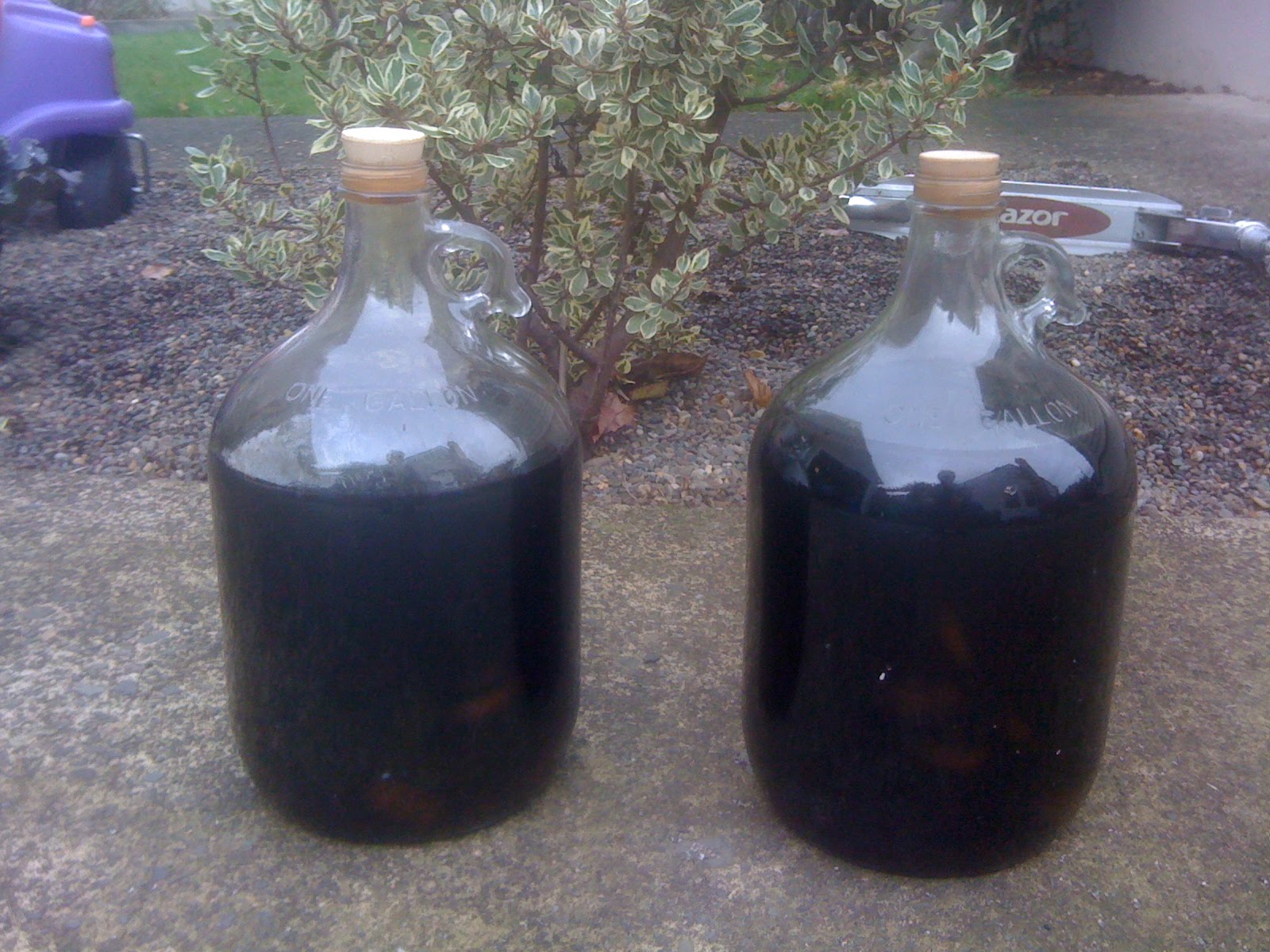
This weekend saw the final act of my nocino (no-CHEE-no) making that began last summer -- bottling and my version of labeling. In July, I picked green walnuts, chopped and soaked them in a variety of liquors and sugar and spices. Two partially full gallon jugs worth sat for months to steep and oxidize and otherwise maderize. Last month I poured the now chartruse brown liquid off the walnuts and sediment to settle some more and continue aging. Now it's December and time to finish things off.

This was my first attempt to make nocino and I thought I would make two jugs worth instead of just one, to have plenty. But after all this time, I figured I'd get only a little more than 4L of liquid. So I found square 250mL bottles and some t-top corks, which would give me between 16 and maybe 18 bottles. That's not too many if you plan to give a bunch away as gifts and keep several for aging, drinking, cooking (nocino whipped cream, anyone?). This stuff is good. So next year I'll have to make even more.

I began by straining the nocino once more through folded cheese cloth, into a tub big enough to combine both jugs. One jug had more sugar, the other less, but a blend turned out to be best. Then I poured the blend carefully back into a jug to make filling each bottle easier, with the little yellow funnel to keep things tidy. The only real challenge was dealing with foam that came from pouring the liquid, as you can see in the jug. I filled each bottle, waited for the foam to subside, then topped up and put a t-top cork into each one All together, I had 18 bottles.

I rinsed off each bottle and let them sit overnight, before heating up yellow sealing wax in a stove top pot to dip the bottle necks. It was tough to get the wax just the right temperature to adhere well to the plastic tops of the t-corks. Finally I got things right, waxing each bottle and dipping the waxed top into cold water to set quickly and give a little shine.

Then a final wipe down and silver Sharpie to sign each bottle in a way that ended up echoing old port and madeira bottles with their white stencil paint. So how does this nocino taste? Think liquid gingerbread with a kick. It's fairly sweet but appropriate to balance the pleasant bitterness of the walnut tannin. What experience I have tasting others' nocino, age should smooth out any rough edges, though this nocino isn't excessively tannic or bitter as I might have feared, being a newbie. In all, I'm very pleased and there are some lucky people out there who will get a bottle.

December 03, 2010

1990 Lopez de Heredia Vina Tondonia Rioja Blanco Reserva

I got home tonight and was compelled to tweet how love is coming home to 1990 Lopez de Heredia Vina Tondonia Rioja Blanco Reserva.

Our neighbor Jamey had mentioned recently on a walk back from the kids' bus stop how he loves this very old school Spanish producer from Rioja, one of my favorites. Tonight he came by with a nice glass pour from the end of the bottle while hosting a Hanukkah dinner. I wasn't home yet but Jennifer graciously accepted such a gift, though Jamey apparently said "you should just drink it all."

Not bad advice. Jamey's no fool.

Jennifer of course saved me half and, upon my return from a long day at work and some play, I put my nose in the glass. How can 20 year old white wine be so fresh? Yes, the wine is aged in oak for several years and intentionally oxidized in the process, softened and opened by time. Then bottled and held for years.

Now, the cork finally out and wine in the glass for drinking, there is an aroma of spiced lemons, wax and a soft, pleasant herbal character from the American oak aging. And a freshness that belies twenty years since the grapes came off the vine. In the mouth, there's richness and acidity, a brightness immediately that amplifies to a full flavor of lemon cream, spicy wood and jelly candies, then acidity to tighten the flavors and carry them nice and long.

There's an impressive dynamic to this wine. It's clearly not simple wine, yet it's not complicated or difficult to enjoy. Perhaps that's a trait of the greatest wines, and while this is not what I'd call "great," it is very, very good and special. Thanks Jamey, and thanks love for saving me some.

December 01, 2010

1995 Taylor Fladgate Quinta de Vargellas Vintage Port

Of the leftovers from Thanksgiving, one wine remains. The last wine, the port. On yet another cold rainy Portland night, it seems fitting to finish it off at last. And reflect on wine of such quality and a small personal story.

I remember finding a little cache of 1995 Taylor Fladgate Quinta de Vargellas Vintage Port several years ago for a remarkably low price (a common story it seems in my cellar). I asked the manager about the price and he said that's what the distributor sent, and maybe it wasn't the right wine (should have been the Late Bottled Vintage, I'm sure), but that's the price, go for it. So I bought six.

Douro Port houses declare "vintage" ports every few years, when the quality is exceptional so that excellent young wines are bottled after two years, sold at a premium and intended to age for decades in the glass. These are the wines collectors prize most. The '77s and '70s, '63s and '45s, among other classic years. Most years produce more basic ruby wines that are bottled early for their grapiness and tawny wines aged longer in cask to develop more nutty qualities. You'll see these commonly for low prices in grocery stores and wine shops, and they provide nice port drinking (and cooking) quality without the depth or price of the more serious wines.

However, there are some particularly good years that may be declared vintages by many houses that for one reason or another aren't declared by others. Typically that happens in years such as 1994 and 1995. '94 was exceptional, and many houses quickly declared the vintage to produce their top wine. However, '95 was also excellent and, had they not declared '94, perhaps '95 would have been the "vintage" year of for a given house. For many, it was declared. For others like Taylor's, you see what I'll call a junior vintage Port, the single quinta (or vineyard) bottling.

We won't fall into the trap and call this wine as good as regular vintage quality. Sometimes wine marketers will make such claims, about single quinta Ports or, for example, Cotes du Rhone from a vineyard "just outside" one fancy appellation or another. This isn't vintage port, plain and simple. But it's darn close and considering the track record of Quinta de Vargellas wines going back to the '50s and earlier, clearly there's longevity and real potential here for development in the cellar.

So how's the wine? Well, young as I would expect, even at 15 years of age. Deep ruby color, with a classic peppery, spirity, mixed berry, fresh tobacco and raisin aroma. The flavor is moderately sweet with excellent richness and fresh acidity, softening tannin and peppery, tobacco flavors to add savory qualities to the plum and berry fruit. The finish is long, slightly warm and simply gorgeous, even after the bottle has been open for nearly a week. There are many dessert wines in the world, but vintage port is one of the most classic and delicious. This wine shows why. Love it.

And a story. I found this wine is early 2002 and brought a bottle to a tasting event where my friend, Roy Hersh of For the Love of Port out of Seattle, brought a bottle of 1935 Sandeman Vintage Port. My young single quinta wine paled in comparison to Roy's special bottle commemorating the coronation of King George VI. But Roy is so gracious. We had a nice conversation about Vargellas, its history producing terrific ageworthy wine. My '95 showed well but young, and time is still a friend here. I'm happy to have more. If you're wondering, that '35 Sandeman was pale ruby and spectacular, everything you could want in old Port. I can still taste it.

The night was particularly memorable. I'd found out that morning that my wife was newly pregnant with our now 8-year-old son Martin, something I couldn't share with anyone because of the fragile uncertainty of things. We were leaving for Australia in the morning to visit family, obviously it had been a big day, and now here were wines by which a guy like me will remember everything. That legend from 1935 and one of several bottles from 1995 that I would open over many years, commemorating that time of life. This Thanksgiving marked the first time since then I'd checked in on the '95 Taylor. I'm happy to have the opportunity to check in again and again.

November 28, 2010

1987 Ravenswood Zinfandel Dickerson Vineyard

I'm not alone in owing my allegiance to zinfandel to things like old Ravenswood zin and David Darlington's book Angels' Visits. These days you might know Ravenswood as a ubiquitous brand on grocery store shelves across the U.S. Back in the day, Ravenswood was a small Somona producer of serious zinfandel, wine at the time considered "big" but downright subtle by today's alcohol and ripeness standards. I can relate to founder Joel Peterson, starting a winery with a day job and a passion or obsession with a certain vision for wine.

Nearly 20 years ago when I got into wine, I first read Angels' Visits, what was a new book at the time. Subtitled An Inquiry into the Mystery of Zinfandel, it was just that -- a journalist's inquiry into the story and appreciation of California zin. If you like wine and wine books, you might have found like I have that you can read a good book about wine, even wine you don't know about or care about, and both LOVE the book and find yourself compelled to seek out the wines mentioned therein. Good travel writing is similar. You read something and find yourself compelled to travel somewhere you would never have guessed. Happily, with wine that travel can be a lot simpler.

Angels' Visits is one of those books, and something that many wine lovers I know will easily suggest if asked about good wine books for a summer trip or just lounging around the house, preferably with a glass in hand. It's set in the late '80s, chronicling the '88 harvest at Ravenswood with lots of juxtaposition with Ridge winery down in the Santa Cruz mountains, another zinfandel legend.

There's also a great recounting of zin's mysterious history in California, somewhat out of date given more recent genetic study of zinfandel's origins but still worth knowing for the CA history and what zinfandel meant twenty and more years ago. There are visits to specific vineyards, like Old Hill and Dickerson, and California wine legends like Darryl Corti of Corti Brothers in Sacramento. There's dinner at Chez Panisse, reason enough to read anything in my mind. And there's homebrewed zin. The author Darlington contributed to my winemaking inspriation by making his own home zin with Ravenswood-sourced grapes as a narrative foil to the zins he observed in production all over northern California during the time he wrote the book.

One of the several threads in the book is the critical reception of the 1987 Ravenswood Zinfandel Dickerson Vineyard. Dickerson is one of the top sites for zin in California, interesting for being in Napa (cabernet country) where most top flight zinfandel comes from Ravenswood's home, Sonoma. Dickerson is known for producing wines with intense minty eucalyptus character, like the old Martha's vineyard in Napa, similarly surrounded by oily eucalyptus trees. Without being a spoiler, near the end of Angels' Visits we learn that Robert Parker of The Wine Advocate has awarded the '87 Ravenswood Dickerson 93 points, then an extremely high score (things have changed in that arena). The implication is that the Dickerson reputation is reaffirmed.

Fast forward to last year when I found a bottle of 1987 Ravenswood Dickerson Zinfandel at auction for a pittance. Why not buy and see if a premise in the book, supported by Parker's reviews at the time, was true - zinfandel could age and Ravenswood Dickerson zin especially could age, perhaps turning Bordeaux-like.

So with Thanksgiving dinner, the American holiday, a quintessential American wine opened alongside a cabernet-based Bordeaux, the 1994 Cos d'Estournel St. Estephe. The Cos was prototypical Medoc wine, gravelly cassis and bell peppery cabernet with resolving tannin, a good amount of French oak, but nice length and savor. I was really impressed with this wine, which is still young but drinking well. By contrast the 1987 Ravenswood Dickerson was evolved, still together and to my taste delicious but clearly on the far end of the evolutionary spectrum. Not tannic as the Wine Spectator apparently complained on release. Lots of eucalyptus notes that people seem to either love or hate (the former for me in this case). And sweet/savory dried red fruit flavors that went well with the earthy flavors of Thanksgiving dinner.

Before you dismiss the zinfandel as an overdone new world mess unfit for any dinner table, note the 13.8% alcohol on the label, back when that was high, justifying Ravenswood's now tired slogan "no wimpy wines." Whatever happened to 13% range zinfandel that can age and match with food, even decades into its life? There are a few still out there, but if you're like me, you're also trolling the auctions to find these lately unwanted gems. And thinking about pulling out Angels' Visits for yet another read. Like some wine, great books can get better with time.

November 23, 2010

2000 Lucien Boillot Pommard Les Fremiers 1er Cru

After a long week+ of all kinds of things in life, I came home last night and simply wanted a really nice bottle of wine. Something to enjoy, to ponder, that would keep me interested all night. Where else to go but Burgundy.

So the 2000 Lucien Boillot Pommard Les Fremiers 1er Cru. Oregon wine fans hear a lot about the Pommard clone of Pinot noir. Cuttings from the Chateau du Pommard in this Cote d'Or village were the source for lots of plant material in California and Oregon, especially the latter.

That doesn't mean our Pommard clone wines taste like wine from the village Pommard. We do prize the earthy quality of Pinot noir wines made from part or all Pommard clone here in Oregon. Tasting the real thing from a top producer, from a premier cru vineyard in the village, it's clear there are echoes what we believe to be true about the Pommard clone. But so much more, including what I can only describe as a real taste of the earth. People debate to no end whether or not mineral flavors (if minerals even have flavor) are present in wine. I can only point to much good Champagne and the taste and texture of chalk. Then to good Cote d'Or Pinot noir like this, with a firm mineral quality that's not acidity or fruit or tannin or barrel flavors. Nor in any other Pinot noir I've tasted outside Burgundy.

So what was this bottle like? At first a little mature, but in a way that suggested it would recapture some youthful freshness as the wine was exposed to air. Don't ask me the science. I just know the experience. The color was young and the elements seemed less mature than the package. Sure enough, the aroma developed a mix of black cherry, sous bois or wet earth, and a distinct cured sweetness that really good aged wine, like aged meat, gets. There was clearly a lot going on with this wine aromatically.

On the palate, there was bright acidity and fine tannin, medium bodied flavors without quite the breadth of the aroma but nice length, lingering with a mineral savor that makes food more interesting as well as the next sip of wine. Essentially, just what you want from a nice bottle of wine. At least, what I consider nice.

November 20, 2010

A field trip to the Eola-Amity Hills

This week, I spent a nice afternoon in the Eola Hills with my friend John Grochau, visiting Mark Bjornson of the Bjornson vineyard and Erin Nuccio, the new owner of Evesham Wood. We were checking with Mark about grapes for the future and took the opportunity to check out Erin in his new digs.

I'm happy to announce that, starting with the next harvest, Vincent Wine Company will source grapes from Bjornson. I can't wait. John has already produced two promising vintages of wine from Bjornson, and Erin started sourcing there in 2010 and will continue. Not bad company for me to be in, I think.

We first ran a few errands in Dundee and McMinnville, making our way down a wet and windy 99W and crossing the Eola Hills on Zena Road. Passed the Zenith vineyard, another Vincent Wine Company site, the vines a mix of yellow leaves and bare branches like all vineyards in the area this time of year. Around and up the hill, we arrived at Bjornson vineyard.

Mark and wife Pattie Bjornson are Minnesotans who first planted this site in 2006. The initial Pinot noir vines came into production with the 2009 vintage, with more blocks like the one pictured coming on line in 2012. The site is just south from the famed Seven Springs vineyard, which is visible from the Bjornson's kitchen through the trees and across the ravine. Not a bad neighborhood.

Bjornson vineyard looks ideal. It has a mix of south, southwest and east exposures, with volcanic Nekia and Jory soils. The pictured block looks due south to Salem and is particularly rocky. Elevation is in the 500' range. The site is LIVE certified and there's even a wind turbine just out of view that provides electricity for vineyard operations. But how does that translate into wine? Based on what I've tasted from barrels at Grochau Cellars, this site produces powerful wines that retain great elegance. Not unlike Seven Springs. This is a different site, but the resemblance is promising.

We tried a few things at Mark's, including brand new Gamay noir made in their barn as well as official 2009 Bjornson Pinot Noir, made by Aaron Hess of Daedalus. The gamay is fresh and should be good home wine. I hope to get some Bjornson gamay grapes in the future. The '09 Bjornson shows nice restraint for the hot vintage, though Mark thinks it's just a bit closed still.

Then down to Evesham Wood close to Salem. Erin was delayed so we walked the estate Les Puits Sec vineyard, here in an old white block looking up to the Tudor style house, with winery in the basement. Very old world feel here. Looking the other way, we would see a great view of Mt. Hood and the Willamette Valley, though the elevation here is lower, only in the 300' to 400' range. The wines from this vineyard prove that elevation isn't everything.

Before Erin arrives, we hang out on the crush pad checking out what's changed from five years ago when I worked the '05 harvest here. Yes, a shot of a younger and thinner me working with Russ. Pushing a drained fermenter into place by the old press, getting ready to empty it out the old fashioned way - with buckets. Even then, cellarmaster Miguel and brother Isaro were talking about a bin dumper. Waiting for Erin, we catch up a bit and the topic of the bin dumper surfaces. It's apparently going to happen.

When Erin arrives, we head into the cellar, seeing Miguel moving a stack of barrels with the funky old stand up forklift that reminds me of the droid/monster Box from the '70s era sci-fi classic Logan's Run. Maybe you had to be an impressionable kid with questionable taste to get see that one.

So we walk back into the barrel cave and start sampling various '09s still resting before bottling in winter or spring. A cask of Les Puit Sec is typically broader and full but with, again, nice restraint for the hot vintage. The lower elevation here mean this site comes in early, a boon in cool years, sometimes tougher in hot years but not this time. Very nice. Then Temperance Hill, '800 above Zenith and Bethel Heights, very ashy Pommard clone character with taut cherry and cranberry flavors. Love the finesse here. A sample of Eola Springs, from the western side of the Eola Hills, shows typical light and bright flavors. Good nerve here.

The Illahe we tried will go in a single vineyard bottling, though most barrels still make up the base of the Willamette Valley cuvee already bottled and released. This sample is floral and perfumed, without too much weight. Then a final taste, from the Bryn Mawr vineyard across the road from Bethel Heights. Not unlike Temperance, which is just up the road. Ashy, cherry, bright. This vineyard has been sold and perhaps Bjornson replaced it in 2010 going forward. Alas, no samples of Bjornson. The 2010s are too new to try, but Erin is excited as is every winemaker I've talked to. Here we see him with wine thief in hand, bathed in backlight and the fuzz of a crap iPhone camera. If you can see his smile, that's Erin. A big smile, and if I were the new owner of Evesham Wood with wines in cask like we just sampled, I would be smiling big too.

A postscript on the transition at Evesham Wood. Erin detailed what we've heard more generally elsewhere. Russ and Mary weren't looking to sell the winery as much as find the right place to hand it down. Apparently they offered it to Erin a while back but it took him a while to say yes. There's a weight to taking on what Russ and Mary built, and just as they wouldn't give it to anyone, Erin's smart enough to know he should make sure he felt up to it. Needless to say, he does, and he's very sensitive to not wanting much change in the approach. I thought pricing might go up, but no, there will be no increases beyond anything ordinary. There will be a bin dumper and already I saw two new presses. But the "Box" fork lift is staying. The farming. The winemaking approach, pretty much everything. Without saying any specifically, Erin mentioned that he and Russ don't agree on everything, which stands to reason. But that only underscores how much they do agree. Haden Fig, Erin's other label, will continue and provide more ground for experimentation. So Evesham Wood fans should be very excited for the future. I know I am.

We bid goodbyes with talk of comparing Bjornson barrels in the spring. That should be good.

November 11, 2010

Nocino update

You may recall my post from July about nocino, the green walnut liqueur made in southern France and Italy and, more and more it seems, Portland, Oregon.

It all started with my friend and Guild Winemakers co-conspirator Anne Hubatch and family holding their annual nocino party on the last weekend in June. That's traditional nocino-making time, when walnuts are sizeable but still immature, the way you want them for nocino.

The Hubatch party had been featured prominently in Mix magazine in 2009, complete with instructions on making your own nocino. We were invited to this year's party but because of the crazy cold and wet spring, the walnuts weren't ready for nocino until mid-July. By then, I'd gotten my neighbor Edward's permission to harvest lots of walnuts from his front yard tree. So with a ladder and tree trimmer turned walnut harvester, I drew the attention of the kids on the block in my quest for perfectly underripe walnuts. With lots of help, I gathers several dozen and took them home to make nocino. After quartering the walnuts, I simply put them into two jugs and poured in white wine, vodka, everclear, cloves, cinnamon sticks, fresh orange peel and varying amounts of sugar as a test. The jugs were intentionally not filled all the way, then left out in the light, heat and cold to oxidize as much as possible over four months.

It's November and time to strain what's become a brackish liquid and check on progress of flavor and aroma development. I'd periodically open and close the tops of the jugs to give a sniff and to get more air in contact with the liquid, to help tame the fierce tannin from the walnuts. Thing really unripe bananas, and think of the oxidizing process as a slow cooking that helps sweeten and cure things until they are delicious. At least that's the idea. Along the way, things smelled great but quick tastes showed lots of raw tannin. I hoped time would help calm that down.

Now, I strained the nocino first through a fine mesh strainer and then again through the strainer lined with cheese cloth. I did a good job catching bits of sediment and the occasional wedge of blackened walnut, which you can see here. The fragrance of the nocino filled the garage where I was working and I couldn't wait to taste the nearly final product.

First I tried the half sugar jug, pouring a bit into a dessert wine glass and holding it outside to get a good look at the color in natural light. This sample was fairly bitter and tannic, definitely in need of either more time, more sugar, or most likely both. Then I tried the full sugar jug and it was much fuller and smoother, if a touch too sweet. I found it interesting that the full sugar batch on the right, which started out lighter presumably because there was less air in the jug (more full because of more sugar), now it's darker. Seems like the sugar caramelized to a browner color while the lower sugar jug on the left maintained more of a honey color, with some browning in the middle but noticeably less than the other.

I originally thought I'd end up bottling the two batches separately, but I found that a mix of the two samples was best of all. Now I'm thinking I'll blend them, but for now I kept things separate. Here are the two jugs of stained nocino in the middle, bracketed by the original jugs with stains on each showing the original fill levels., before I shook out the walnuts (which didn't take more than a minute for each jug). I'll let the strained nocino sit for a few more weeks to settle out more sediment, then perhaps strain again and pour into little bottles for keeping and giving. Neighbor Edward will get some, as will the Hubatch family. I'm definitely saving some for the future. I've seen that nocino can improve dramatically for a few years. But I'm sure a few other bottles will find their way into other hands. Nothing like nocino for the holidays.