Merry Christmas, dear reader. I'm home this year after several holidays at my childhood home in Los Angeles. Everything is focused on home, how good home feels, especially at Christmas.
For me, wine is always secondary at the holidays. Essential for the great holiday meals. Enjoyable for visiting with neighbors, family and friends. Just not the focus, and not necessarily the best match for my favorite holiday foods. One thing I'm missing this year in Portland are some good tamales, something I'd like to make fresh for Christmas one of these years, once I learn how to make them.
On Christmas night, it's just the family at home at the 1998 Laurel Glen Cabernet Sauvignon Sonoma Mountain and flat iron steak, a onion and gruyere tart, Brussels sprouts (yes, named for the city) and the most essential of holiday foods, the mashed potato. Dinner will surely be delicious.
But the wine? It is mature, lovely and ready now but I'm sure has the staying power this producer is known for. This is aromatic cabernet, more in the Loire style than Bordeaux, more about tobacco and herbs and the caramelization of age than heavier, richer cabernet of the Medoc. If you're into that, and I am, this is a wine you will love, treasure even. Something you'll keep when others might not, sure you'll be rewarded. I'm sure you will.
This is how Christmas should be. Home. And for those who can't be home yet, a taste of what will be.
December 25, 2011


December 08, 2011
Harvest 2011 part 7: celebration
Harvest 2011 in Oregon's Willamette Valley is complete. The grapes picked, the new wines safely through fermentation and in barrel (unless you're Barnaby at Teutonic Wine Company, who told me last week that he was picking his last riesling on Saturday - December 3!).
All that remains is the harvest celebration. This year the Guild Winemakers bunch celebrated together, a low key gathering of partners to talk about the harvest and anything else that came to mind. Such get togethers never last long enough. Why can't meals with friends last for days instead of hours?
 I thought it appropriate to mark the occasion with an older wine I recently found. So the 1987 Nozzole Chianti Classico Riserva, pale in candlelight, brilliantly translucent, more than alive, growing with airtime to show its Tuscan sangiovese roots and all the layers of time. Not a great wine, but certainly pleasurable, much more than just a novelty of the past, so beautiful.
This harvest, this whole year was incredible. Unusual. Something I don't want to go through again. But the results are incredibly exciting. The wines we have in barrel taste electric. Ripe with a burst of flavor and yet so full of energy, so lively. They need to settle down and complete the secondary malolactic fermentation, which softens the young wine. Then time in barrel and bottle. Time will be everything for these wines.
We won't really see what we have for ten years, though of course we will check in frequently along the way, in cask and bottle. Already barrels need topping up only a few weeks after being filled. Otherwise, there is little to do now that harvest is done. This time is the elevage, the education of the wine, requiring patience.
So we eat and drink and finish the year, glad to be through with harvest and ready now for everything else a year brings. Harvest will be back again soon enough. But let's drink a little more old Chianti before thinking about that.
All that remains is the harvest celebration. This year the Guild Winemakers bunch celebrated together, a low key gathering of partners to talk about the harvest and anything else that came to mind. Such get togethers never last long enough. Why can't meals with friends last for days instead of hours?

This harvest, this whole year was incredible. Unusual. Something I don't want to go through again. But the results are incredibly exciting. The wines we have in barrel taste electric. Ripe with a burst of flavor and yet so full of energy, so lively. They need to settle down and complete the secondary malolactic fermentation, which softens the young wine. Then time in barrel and bottle. Time will be everything for these wines.
We won't really see what we have for ten years, though of course we will check in frequently along the way, in cask and bottle. Already barrels need topping up only a few weeks after being filled. Otherwise, there is little to do now that harvest is done. This time is the elevage, the education of the wine, requiring patience.
So we eat and drink and finish the year, glad to be through with harvest and ready now for everything else a year brings. Harvest will be back again soon enough. But let's drink a little more old Chianti before thinking about that.
November 29, 2011
Harvest 2011 part 6: barreling

Filling barrels means washing barrels first, then smelling them to see if they're fit for wine. These two look beautiful and smell sweet and fresh despite a few years of prior use. Good French oak - all we use - is a wonderful thing for wine.
Each barrel gets filled and tagged with a note on what's inside. Barrels are paired side by side on racks, the racks then stacked three high and put away into the barrel storage area.
To wait. And wait.
Through the winter and spring, when the malolactic fermentation will happen, softening what are now young, raw wines. Then into the summer, before the wines will be drawn off the fine sediment that settles out in barrel and blended for bottling before the next harvest.
Once the last barrel is filled and the final tanks and hoses cleaned out, harvest is done. Now it's time for a harvest dinner to celebrate the vintage. Tomorrow night in fact, I can't wait.
November 27, 2011
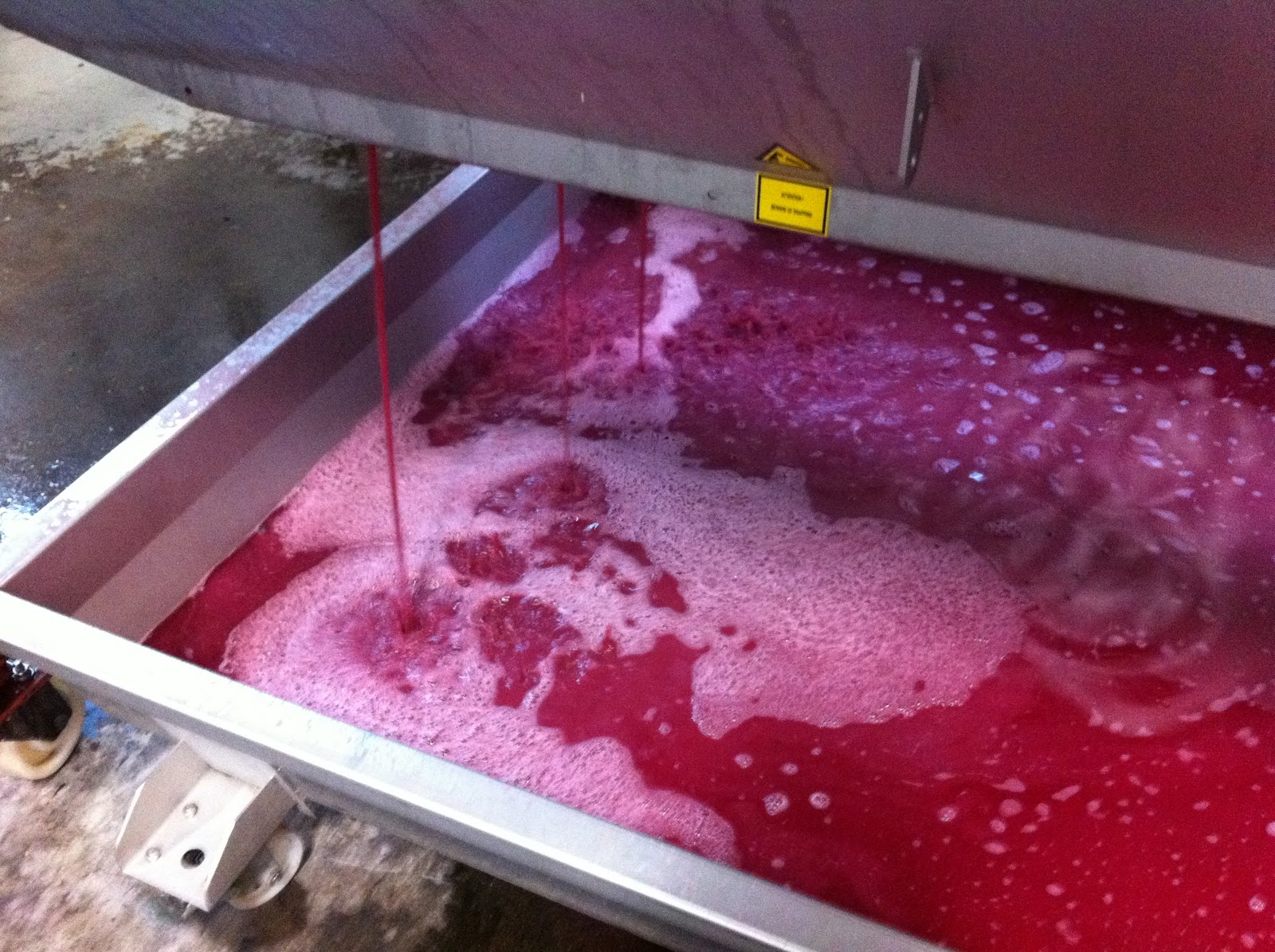
Harvest 2011 part 5: draining

We begin by tipping a small fermenter and putting a siphon into the grapes and new wine.

As the wine is gently pumped out, the grape skins floating on the surface of the liquid gradually drop to the bottom of the bin. I like how they cling to the top of the "torpedo" that sucks out the wine.



November 21, 2011
Harvest 2011 part 4: plunging
or |
| Pumping over Vincent Pinot Noir, once early on to give oxygen to the yeast. |
 |
| Plunging Bjornson vineyard, never shy on color. Very interesting, muscular Pin |
 |
| I'm not about color in Pinot noir, but this is remarkable nonetheless. |
November 16, 2011
Harvest 2011 part 3: waiting
Last time I wrote about bringing in several tons of Pinot noir from
Armstrong Vineyard on this past October 20. Turns out that same day, we
also brought in Vincent Wine Company's one ton of Pinot from Zenith
Vineyard in the Eola-Amity Hills. With the three fermenters full of
Armstrong fruit, we ended the day with four full fermenters of destemmed
grapes ready to become wine.
So how does that happen? Every which way you can imagine. You can add yeast or let ambient yeast spontaneously ferment the grapes. You can chill the grapes before they start to ferment to let them "cold soak," so that color, texture, flavor and aroma elements in the grapes can gently steep into the grape juice before alcohol has been created. You can heat the grapes to encourage fermentation, much as you might put dough in a warm place to rise. You can add nutrients to feed the yeast and keep them healthy. Sugar to boost alcohol levels in the finished wine in cold years like this one. Acidity to boost acid levels if the grapes are too ripe (not much of an issue this year). Tannin to fix color and, yes, soften the texture of the finished wine. Enzymes to help the grape matter break down more readily, for enhanced extraction. Sulfur dioxide as a preservative. You name it.
No matter what you choose to do or not do in your winemaking, fermentation is all about sugar in the grapes and grape juice changing into alcohol, producing carbon dioxide and heat in the process. The winemaker simply wants to guide the process. Our process is to do that extremely minimally. This year the approach was this:
In the end, we saw some nicely flavored and colored wines from Armstrong and Zenith. Good raw material you might say, fully ripe tasting but with alcohols in the 12.5% and bright acidity, wine that will change dramatically in barrel but already you know it's going to be good. 2011 is that kind of year.
So how does that happen? Every which way you can imagine. You can add yeast or let ambient yeast spontaneously ferment the grapes. You can chill the grapes before they start to ferment to let them "cold soak," so that color, texture, flavor and aroma elements in the grapes can gently steep into the grape juice before alcohol has been created. You can heat the grapes to encourage fermentation, much as you might put dough in a warm place to rise. You can add nutrients to feed the yeast and keep them healthy. Sugar to boost alcohol levels in the finished wine in cold years like this one. Acidity to boost acid levels if the grapes are too ripe (not much of an issue this year). Tannin to fix color and, yes, soften the texture of the finished wine. Enzymes to help the grape matter break down more readily, for enhanced extraction. Sulfur dioxide as a preservative. You name it.
No matter what you choose to do or not do in your winemaking, fermentation is all about sugar in the grapes and grape juice changing into alcohol, producing carbon dioxide and heat in the process. The winemaker simply wants to guide the process. Our process is to do that extremely minimally. This year the approach was this:
- Pick and process the grapes
- Let them soak at ambient temperature until they begin to ferment on their own
- Do one "pump over" - using a pump to suck out the juice at the bottom of the fermenter and spraying it over the top, to mix the juice and give air to the yeast
- Do nothing for days until fermentation is active enough so you get a little hit from the carbon dioxide of fermentation
- That means nothing - no punch downs or pump overs - just a little spritz of sulfur if necessary to keep things fresh
- Once fermentation is nice and active - after about 10 days - the first punch down is highly aerative to feed the yeast more
- Then punchdowns once a day for the six to eight days as the yeast convert sugar to alcohol and temperatures in the fermenter get into the 80sF if not 90F.
- Drain the new wine and press the grape skins to get everything out
- Let the new wine settle for a couple days, then put into barrel for the winter
In the end, we saw some nicely flavored and colored wines from Armstrong and Zenith. Good raw material you might say, fully ripe tasting but with alcohols in the 12.5% and bright acidity, wine that will change dramatically in barrel but already you know it's going to be good. 2011 is that kind of year.
November 14, 2011
Harvest 2011 part 2: grapes!

In most years, October 20 would see the last grapes coming in to local wineries. Ok, some late, late pickers and people who make Riesling would still be holding on. The point remains, this was a very late beginning to harvest and yet look at the sky. Beautifully blue, the ground dry, even a bit dusty after more than a week of dry weather (that would continue almost through the month).

I always like to taste berries and occasionally chomp into a cluster to see how things taste, careful to avoid seeds. This year, the flavors are ripe but the acidity seems strong, giving a fresh quality to the flavors, an energy that I'm looking for. The grape skins seem relatively thick, perhaps because of the cool year, and I think that I want to make sure the wines don't end up too tannic. File that thought away.

From here, the clusters go through the destemmer to separate the grapes from their stems, dropping the berries into a fermenter waiting below. We end up filling three small fermenters with the fruit from three different blocks at Armstrong, each to be fermented and barrel aged separately before we blend in about year before bottling. Now comes the waiting period, where the grapes sit undisturbed until they ferment on their own. This year, as usual, it takes several days to begin. More on that next time.
November 12, 2011
Harvest 2011, part 1 - it's a miracle
 Yes, always.
Seriously, that has to be the answer if anyone ever again asks if the harvest is going to turn out. After this year, how could you say any different?
In the brief history of wine grape growing in Oregon's Willamette Valley, this year was historically cold and late. How late? Bud break in Pinot noir vines that should be in full swing in mid-April was still happening after Mother's Day because spring was so wet and cold. Flowering should happen by mid-June. This year it finally occurred on and after the fourth of July for the same reason. But the weather was great for flowering, meaning that lots of flowers that might have been knocked off by June wind and rain actually set as fruit, making for a potentially huge crop that might never get ripe. So growers immediately went into major triage mode, cutting off lots of new grape clusters to reduce the size of the crop in the hope of making sure what remained on the vines would actually ripen. Crop thinning happens every year, but this year it was more important than ever.
A nice benchmark for grape growing locally is that you might harvest grapes 100 days after flowering. So when flowering peaked in early July, I wrote here that we might begin picking around October 12. Ideally you would get more than those 100 days to further develop grape flavors and tannin, but this year that would put harvest into late October and early November for the coolest sites. If you don't know Willamette Valley weather, understand that we have warm and dry summers that often last into October. This is a great place for grape growing. But ask any kid around here - come Halloween it's usually cold, wet and windy. You really don't want to be sitting there in July thinking about harvesting grapes around Halloween, so you can imagine how hard it was to stay optimistic this year.
July proceeded to be relatively cool though dry, with August continuing the dry streak and summer temperatures finally coming on strong. I believe we didn't hit 90F locally until mid-August, ridiculously late for such a benchmark. Then the season began to turn in our favor. September was warmer overall than July and we entered October still facing a mid-month start to harvest, but on the cusp of something special if the weather held out.
It didn't, at least at first. Early October saw a quick change to autumn with cold temps and rain. Immediately we saw media reports of a ruined harvest, before any grapes had been picked. I'll admit, it was hard to remain optimistic, but what choice did we have? Then the skies cleared and the rest of October was amazingly mild and notably dry, perfect for ripening grapes. Finally, on October 20 it was time for our first pick of the season, at Armstrong vineyard on Ribbon Ridge.
How did it go? The picture at the top shows the sunrise October 20 from Bell Road as I made my way out to the vineyard. No fog, no rain, just a beautiful, perfect morning that told me we indeed had something special about to happen. Stay tuned for part 2, which won't take another month to write up. Harvest is finally about done and I couldn't be more excited for the results. Plus, now I have a little free time again.
October 19, 2011
Harvest 2011 begins, finally
Harvest 2011 begins Thursday for Vincent Wine Company. We’re picking
everything from our blocks at Armstrong Vineyard on Ribbon Ridge and
Zenith Vineyard in the Eola-Amity Hills. I am so excited. After this
crazy growing season, where historic cold weather delayed budbreak until
May and flowering until July, we’re near the end of October and finally
we pick grapes.
How is the quality? We won’t really know until we have the fruit in the fermenters, but sugar levels are in the low 20s brix and pHs are in the 3.2 to 3.3 range. Just where I want them, for making wines with ripe flavors but energy, life, acid balance. Flavors are mixed, meaning some pretty explosive tasting berries and others with some bracing qualities that I prize. Let’s remember, we’re making wine, not fruit juice or eating grapes. I think grape flavors are overrated. Wine is a curing process. We’re taking raw meat and making bacon. There’s a big difference in the two. I’m looking for something in the final product that you can’t necessarily see in the raw material. What I want now are healthy, ripe grapes from a successful growing season. We have that.
And what a crazy growing season it was. A good indicator of a growing season here is at least 100 days from flowering until harvest, maybe 110 or longer depending on the season. Our early July flowering meant 100 days would be around October 12. In many years, we’d finish picking at that time. This year we knew we probably wouldn’t even begin until then. Crazy. Harvest is an outdoor activity. Does anyone think that outdoor events in the Willamette Valley in mid-October or later is a good idea?
Now, on the eve of October 20, we will finally pick. The grapes have had a long season after all. Turns out we’ve gotten the weather we need and things are turning out. I wouldn’t advise more seasons like this. Don’t plan an outdoor wedding this time of year. But for now, it looks like we might get lucky.
Stay tuned for more on harvest. Now I need some sleep. Tomorrow is going to be a long, and I hope great, day.
How is the quality? We won’t really know until we have the fruit in the fermenters, but sugar levels are in the low 20s brix and pHs are in the 3.2 to 3.3 range. Just where I want them, for making wines with ripe flavors but energy, life, acid balance. Flavors are mixed, meaning some pretty explosive tasting berries and others with some bracing qualities that I prize. Let’s remember, we’re making wine, not fruit juice or eating grapes. I think grape flavors are overrated. Wine is a curing process. We’re taking raw meat and making bacon. There’s a big difference in the two. I’m looking for something in the final product that you can’t necessarily see in the raw material. What I want now are healthy, ripe grapes from a successful growing season. We have that.
And what a crazy growing season it was. A good indicator of a growing season here is at least 100 days from flowering until harvest, maybe 110 or longer depending on the season. Our early July flowering meant 100 days would be around October 12. In many years, we’d finish picking at that time. This year we knew we probably wouldn’t even begin until then. Crazy. Harvest is an outdoor activity. Does anyone think that outdoor events in the Willamette Valley in mid-October or later is a good idea?
Now, on the eve of October 20, we will finally pick. The grapes have had a long season after all. Turns out we’ve gotten the weather we need and things are turning out. I wouldn’t advise more seasons like this. Don’t plan an outdoor wedding this time of year. But for now, it looks like we might get lucky.
Stay tuned for more on harvest. Now I need some sleep. Tomorrow is going to be a long, and I hope great, day.
October 13, 2011
Harvest approaches in the Willamette Valley
It's weird to say in mid-October that harvest hasn't really started in the Willamette Valley. Yes, some white grapes are in. The Pinot, however, waits. Along with pretty much everything else.
This year is indeed historic. Cold. Late. Essentially unprecedented. In response, growers have mostly cut back to one cluster of grapes per vine shoot. The idea is to limit the grape crop to make sure what you still have on the vines will get ripe, even in an historically cold year.
The funny thing is, flowering took place during perfect weather around July 4. Late, but perfect. As a result, grape clusters on average are well above normal. We still haven't picked, but I'm seeing 150g to 200g clusters of Pinot Noir. Usually that might be 80g to 120g or so, depending on the clones or types of Pinot Noir sub-varieties.
I'm thinking the story this year isn't the cold weather or late harvest. September was like July should have been. We've had a nice growing season. The clouds are due to break and we should have nice gusty, warm drying winds next week. Things look good on the grape front.
Once the grapes are picked, the story will be big yields even when people tried to cut back. Those big clusters, even just a handful or two per vine, add up to more tonnage per acre. If clusters are at least 50% bigger than normal, that's going to be a lot more wine to put into barrel than we might have been expecting.
As I say too much, but it's true - stay tuned.
This year is indeed historic. Cold. Late. Essentially unprecedented. In response, growers have mostly cut back to one cluster of grapes per vine shoot. The idea is to limit the grape crop to make sure what you still have on the vines will get ripe, even in an historically cold year.
The funny thing is, flowering took place during perfect weather around July 4. Late, but perfect. As a result, grape clusters on average are well above normal. We still haven't picked, but I'm seeing 150g to 200g clusters of Pinot Noir. Usually that might be 80g to 120g or so, depending on the clones or types of Pinot Noir sub-varieties.
I'm thinking the story this year isn't the cold weather or late harvest. September was like July should have been. We've had a nice growing season. The clouds are due to break and we should have nice gusty, warm drying winds next week. Things look good on the grape front.
Once the grapes are picked, the story will be big yields even when people tried to cut back. Those big clusters, even just a handful or two per vine, add up to more tonnage per acre. If clusters are at least 50% bigger than normal, that's going to be a lot more wine to put into barrel than we might have been expecting.
As I say too much, but it's true - stay tuned.
September 29, 2011
End of the growing season
The winegrape harvest in the northern Willamette Valley is so close. In a normal year, I would be picking pinot noir from lower elevation warmer sites. This year we are still weeks away, with doom on the horizon.
Portland, where I am, saw delightful autumn weather today. A cool morning, then sunny skies with temperatures in the low 80s for a while in the afternoon. September has been warmer than July, just when we needed it after such a cold season. Vineyards have really been progressing this month. If things could hang on, you're thinking this could be classic.
Until you see the forecast. Cold, windy and rainy. Perhaps epic amounts of precipitation. Or maybe it's just the usual soaking here and there, with dry times in between, bad but now awful. Either way, tough.
Which makes me think of harvest 2005. The calendar is the same this year as 2005, and Thursday the 29th, 2005, was the last in a string of lovely days. The next three days saw two inches of rain in Portland, ushering in a month of on and off again rain and maybe two days at 70F or higher in October.
The moral of story. Oh my god. No, seriously, October can be cold and wet. We just need to deal with it, especially in what has been exceptionally cold and wet growing season. We just need to pick low brix, high acid pinot noir and make great wine, like people do elsewhere in the world with the same situations. I'm kind of excited about it. [what I don't want is rot and mold from rain and generally damp conditions. We'll see about that.]
So, it's going to be a long two weeks before I think we might start picking at one of our sites. The other two will be another week at least. What a late and, now, possibly wet harvest. All you can do now is watch the skies.
Portland, where I am, saw delightful autumn weather today. A cool morning, then sunny skies with temperatures in the low 80s for a while in the afternoon. September has been warmer than July, just when we needed it after such a cold season. Vineyards have really been progressing this month. If things could hang on, you're thinking this could be classic.
Until you see the forecast. Cold, windy and rainy. Perhaps epic amounts of precipitation. Or maybe it's just the usual soaking here and there, with dry times in between, bad but now awful. Either way, tough.
Which makes me think of harvest 2005. The calendar is the same this year as 2005, and Thursday the 29th, 2005, was the last in a string of lovely days. The next three days saw two inches of rain in Portland, ushering in a month of on and off again rain and maybe two days at 70F or higher in October.
The moral of story. Oh my god. No, seriously, October can be cold and wet. We just need to deal with it, especially in what has been exceptionally cold and wet growing season. We just need to pick low brix, high acid pinot noir and make great wine, like people do elsewhere in the world with the same situations. I'm kind of excited about it. [what I don't want is rot and mold from rain and generally damp conditions. We'll see about that.]
So, it's going to be a long two weeks before I think we might start picking at one of our sites. The other two will be another week at least. What a late and, now, possibly wet harvest. All you can do now is watch the skies.
September 28, 2011
2010 Vincent Wine Company Pinot Tasting
Readers may recall that I make wine. When I pour my wines, it's always fun meeting people who read this site. I'm holding another event this weekend and readers, please, come and taste my latest wines.
I'm releasing all my 2010 Pinot Noirs this Sunday, October 2, 1-5pm at the Slate, a mixed use space at 2001 NW 19th Avenue in Portland. I'll be pouring with friend and Guild Winemakers partner Anne Hubatch, who will be sampling her latest release of Helioterra wines.
It's a drop in thing, very casual, open to the public. There is no charge to taste. We will be selling all our new releases, so please buy wines that you like. The holidays are coming.
I will have small amounts of both of my 2010 single vineyard bottlings available. 2010 is the third year I've made Zenith Vineyard wine, all Pommard clone on a shallow soiled knoll in the vineyard. Red fruited, delicate and subtle, aged completely in older oak. The prettiest wine I've made.
This is the first year of Armstrong Vineyard from Ribbon Ridge, on Lewis Rogers Lane just down from Ayres and Brickhouse. Darker, more black-fruited wine as you would expect here. 25% new oak, good density, a more substantial wine.
A few local shops and restaurants will have these wines, but not many. And not for long. Hope you can join us this Sunday to taste.
I'm releasing all my 2010 Pinot Noirs this Sunday, October 2, 1-5pm at the Slate, a mixed use space at 2001 NW 19th Avenue in Portland. I'll be pouring with friend and Guild Winemakers partner Anne Hubatch, who will be sampling her latest release of Helioterra wines.
It's a drop in thing, very casual, open to the public. There is no charge to taste. We will be selling all our new releases, so please buy wines that you like. The holidays are coming.
I will have small amounts of both of my 2010 single vineyard bottlings available. 2010 is the third year I've made Zenith Vineyard wine, all Pommard clone on a shallow soiled knoll in the vineyard. Red fruited, delicate and subtle, aged completely in older oak. The prettiest wine I've made.
This is the first year of Armstrong Vineyard from Ribbon Ridge, on Lewis Rogers Lane just down from Ayres and Brickhouse. Darker, more black-fruited wine as you would expect here. 25% new oak, good density, a more substantial wine.
A few local shops and restaurants will have these wines, but not many. And not for long. Hope you can join us this Sunday to taste.
September 01, 2011
Late summer

It's summer and everything and nothing is going on. The tomatoes are coming on. The sunflowers tall and lanky.
And the nocino sits in the garden, baking in the daylight and heat. Brown now, the color of coffee but thicker. Chartreuse even, when sloshed around. The nocino will stay out here until November and still be a touch raw then.
Meanwhile I just got back from a short visit to the southern Okanagan Valley of central British Columbia. More on that later. But it's amazing how driving up US 97 through Washington, you go from nowhere Washington to the vibrant Okanagan valley on the Canadian side.
Immediately across the border it's orchards and vineyards tucked in remarkable places above the lake and below the glacier-carved granite walls. Truly wonderful landscape, and amid lots of good wine, I found what might be great wine. Certainly the best dry wine I've tried from BC. More later
- Posted using BlogPress from my iPhone
July 14, 2011
Reading KCole
I'm on vacation in California - non-wine vacation, with family - so maybe that explains my absence. There just isn't too much to write about, what with hiking in the Sierra and playing some golf, drinking cold beer and eating too much, now in the SF area for a few days to see in-laws before a weekend return to Portland.
However, I have been reading. For pure pleasure, I'm reading Fitzgerald's Tender is the Night. And for "work" I'm reading Katherine Cole's Voodoo Vintners: Oregon's Astonishing Biodynamic Winegrowers. I'll review it slightly more formally when I finish it, soon.
For now, Cole is simply a pleasure to read, making Fitzgerald wait or at least share the bedside table. I wasn't sure what she would write about biodynamics, but as I tweeted last week when starting the book, she brings a nice mix of intrigue and healthy skepticism to the topic. The result is a lovely profile of the Oregon wine scene, which in reflection is centered more on biodynamics than I realized. I highly recommend it to any wine geek interested in Oregon, biodynamics, and ideally both.
However, I have been reading. For pure pleasure, I'm reading Fitzgerald's Tender is the Night. And for "work" I'm reading Katherine Cole's Voodoo Vintners: Oregon's Astonishing Biodynamic Winegrowers. I'll review it slightly more formally when I finish it, soon.
For now, Cole is simply a pleasure to read, making Fitzgerald wait or at least share the bedside table. I wasn't sure what she would write about biodynamics, but as I tweeted last week when starting the book, she brings a nice mix of intrigue and healthy skepticism to the topic. The result is a lovely profile of the Oregon wine scene, which in reflection is centered more on biodynamics than I realized. I highly recommend it to any wine geek interested in Oregon, biodynamics, and ideally both.
July 05, 2011
"Everybody's playing in the heart of gold band..."
 I've long wondered if that Robert Hunter lyric above was a reference to Neil Young's song Heart of Gold. I do know Edmunds St. John's white wine bottling of that name is a Neil Young reference. It's also absolutely delicious in the 2008 edition I picked up locally not too long ago.
The 2008 Edmunds St. John Heart of Gold is a blend of Grenache Blanc, a classic white Rhone variety, and Vermentino, known as Rolle in France. It is gorgeous. Inspirational even. I'd love to explore white grapes like these in my wine production here in the the Pacific Northwest. Note to self - research who's growing stuff like this within a few hours of Portland.
The wine fittingly has a lovely light gold color. The aroma is similarly golden and something I think wine lovers everywhere could love even if they've never heard of these lower profile grapes. There are aromas of lemons, minerals, pastry dough and the exotic scent of stone fruit flesh and pits. Not quite peach or apricot, maybe something between.
The flavors are zippy and bright, with lemons and a waxy roundness. There's perhaps a touch of heat from alcohol, but it just adds to the body and intrigue of the wine. The finish lingers. I love this wine, and for $15 or so locally, you can't go wrong.
July 04, 2011
Flowering
I took a drive yesterday to see signs of Pinot Noir flowering in the Willamette Valley, on a beautiful summer afternoon. Usually the Pinot flowers locally in the middle of June, roughly. This year, like last year, is late following a cool, damp spring. Talking with growers over the past few weeks, I heard July 4 as a target date for flowering, as it was in 2010. There were hopeful suggestions of "by July 4, for sure, definitely" to lightly desperate humor: "if not by July 4, then, um, maybe a November harvest?"

Surely not. Conventional wisdom is that harvest might begin 100 days after flowering at a given site. Longer than that you have longer "hang time," the grapes usually benefiting from extra time to develop aromas and flavors, with riper tannin and still, if the weather is cool at night, fresh acids.
Warmer sites and younger vines can ripen a bit more quickly, but 100 days is a nice estimate for thinking of the arc of the growing season. One hundreds days from July 4 is October 12. Last year, I picked from October 8 to October 17. If flowering happens similarly this year, I think it's safe to bet we'll have a similar window for picking, later if possible if the weather holds in October, likely not too much earlier, ideally under dry conditions regardless.
Sure enough, I saw a bunch of flowering inflorescence. I first drove by a couple sites I don't work with in the northern Willamette Valley, but was curious to check out. The first site seemed maybe a third through flowering, the second perhaps half or more in the rows I saw. Exciting.
Then over Bald Peak and down to Ribbon Ridge to the Armstrong Vineyard. I was really hoping to see flowers now. I wasn't disappointed. I drove up and found grower Doug Ackerman at work at the barn and we went for a walk around the property. According to him, there were no flowers the day before, but now flowering was visible in 5 to 10% of the clusters. Surely with sunny, warm weather in store for days, flowering will be quick and even, as ideal as you could want.

Here's a cluster in the clone 667 block. Grape flowers self pollinate, so there aren't dramatic blooms or aromas in grape flowers. There is a musky fragrance if you get up really close though. You can see how some grapes have set and others haven't. An "even" set means everything will set together, so this cluster should have had more flowers by the end of the day and ideally today is in full bloom. That way, the grapes are more likely to ripen together come October.

With flowering under way in such lovely conditions, it seemed appropriate to admire the view.

And a nice moment to celebrate with the most summery of beverages, dry rose wine. Thanks Doug!

Surely not. Conventional wisdom is that harvest might begin 100 days after flowering at a given site. Longer than that you have longer "hang time," the grapes usually benefiting from extra time to develop aromas and flavors, with riper tannin and still, if the weather is cool at night, fresh acids.
Warmer sites and younger vines can ripen a bit more quickly, but 100 days is a nice estimate for thinking of the arc of the growing season. One hundreds days from July 4 is October 12. Last year, I picked from October 8 to October 17. If flowering happens similarly this year, I think it's safe to bet we'll have a similar window for picking, later if possible if the weather holds in October, likely not too much earlier, ideally under dry conditions regardless.
Sure enough, I saw a bunch of flowering inflorescence. I first drove by a couple sites I don't work with in the northern Willamette Valley, but was curious to check out. The first site seemed maybe a third through flowering, the second perhaps half or more in the rows I saw. Exciting.
Then over Bald Peak and down to Ribbon Ridge to the Armstrong Vineyard. I was really hoping to see flowers now. I wasn't disappointed. I drove up and found grower Doug Ackerman at work at the barn and we went for a walk around the property. According to him, there were no flowers the day before, but now flowering was visible in 5 to 10% of the clusters. Surely with sunny, warm weather in store for days, flowering will be quick and even, as ideal as you could want.

Here's a cluster in the clone 667 block. Grape flowers self pollinate, so there aren't dramatic blooms or aromas in grape flowers. There is a musky fragrance if you get up really close though. You can see how some grapes have set and others haven't. An "even" set means everything will set together, so this cluster should have had more flowers by the end of the day and ideally today is in full bloom. That way, the grapes are more likely to ripen together come October.

With flowering under way in such lovely conditions, it seemed appropriate to admire the view.

And a nice moment to celebrate with the most summery of beverages, dry rose wine. Thanks Doug!
June 29, 2011
Summer
Summer has arrived in the Willamette Valley of Oregon. A cold summer so far, after a cold and wet spring. That means the grape growing season locally is several weeks behind schedule. Where grape vine flowering might typically happen in mid-June, we're still waiting for flowering and will perhaps wait another week or more, depending on the exact site.
What does that mean? No one here is going to be picking grapes in September, the end of which usually sees the start of the Pinot Noir grape harvest. Which means, local winemakers like me will be free at the end of September. Not something we usually expect. What to do? What to do?
It also means that we'll be picking grapes as we did in 2010 and 2008. In the middle of October and later. We at Vincent Wine Company are unconcerned.
I mentioned to one of my growers today that I'm excited for harvest. He said, pray for sun and warmth. Really, we'll get what we get and, as far as I'm concerned, too much ripeness is more of a concern even in the "cool climate" of the Willamette Valley.
I was enjoying some nice Sherry and conversation a recent evening with a winemaker friend and his point was, aren't the benchmark wines from Oregon that we revere - the old school stuff from years back - from a time where crop loads weren't so manicured? Where ripeness wasn't so great? He's right. So let's not worry about ripeness. We'll be fine.
Meanwhile, life at Vincent Wine Company rolls on. In the marketplace, our 2009 Vincent Pinot Noir Eola-Amity Hills is almost sold out. I'm trying to dole out the last 40 cases or so over the summer to key accounts. The goal is to not have too much of a gap in availability before the first 2010s come out. More on that in a minute.
Lately, I've delivered to restaurants like South Park, Nel Centro, Tabla and Noble Rot. All venues that have been selling my wine and want more, which is a great thing. Division Wines, a new shop in SE Portland owned by Will Prouty, the buyer at South Park, took a few cases. Storyteller Wine Company brought in some more as well. Pastaworks and Foster & Dobbs in NE Portland as well.
My goal this year has been to find the places where my wine resonates. Where the staff gets behind it and finds customer homes and tables to take it in. Restaurants where the staff likes the wine and feels good recommending it.
Which brings me to 2010. The wines will go into bottle in August and release this fall. My conspirators in Guild Winemakers were over the other night to taste through all the barrels and I think I have four different Pinots on tap for 2010:
Meanwhile, I'll regularly visit the three vineyards I'm working with this year. Look for updates all summer long.
What does that mean? No one here is going to be picking grapes in September, the end of which usually sees the start of the Pinot Noir grape harvest. Which means, local winemakers like me will be free at the end of September. Not something we usually expect. What to do? What to do?
It also means that we'll be picking grapes as we did in 2010 and 2008. In the middle of October and later. We at Vincent Wine Company are unconcerned.
I mentioned to one of my growers today that I'm excited for harvest. He said, pray for sun and warmth. Really, we'll get what we get and, as far as I'm concerned, too much ripeness is more of a concern even in the "cool climate" of the Willamette Valley.
I was enjoying some nice Sherry and conversation a recent evening with a winemaker friend and his point was, aren't the benchmark wines from Oregon that we revere - the old school stuff from years back - from a time where crop loads weren't so manicured? Where ripeness wasn't so great? He's right. So let's not worry about ripeness. We'll be fine.
Meanwhile, life at Vincent Wine Company rolls on. In the marketplace, our 2009 Vincent Pinot Noir Eola-Amity Hills is almost sold out. I'm trying to dole out the last 40 cases or so over the summer to key accounts. The goal is to not have too much of a gap in availability before the first 2010s come out. More on that in a minute.
Lately, I've delivered to restaurants like South Park, Nel Centro, Tabla and Noble Rot. All venues that have been selling my wine and want more, which is a great thing. Division Wines, a new shop in SE Portland owned by Will Prouty, the buyer at South Park, took a few cases. Storyteller Wine Company brought in some more as well. Pastaworks and Foster & Dobbs in NE Portland as well.
My goal this year has been to find the places where my wine resonates. Where the staff gets behind it and finds customer homes and tables to take it in. Restaurants where the staff likes the wine and feels good recommending it.
Which brings me to 2010. The wines will go into bottle in August and release this fall. My conspirators in Guild Winemakers were over the other night to taste through all the barrels and I think I have four different Pinots on tap for 2010:
- Armstrong vineyard bottling - 50 cases
- Zenith vineyard bottling - 50 cases
- A Ribbon Ridge appellation bottling that will be the main wine, replacing '09s' Eola-Amity Hills - 170 cases
- And a limited Willamette Valley bottling geared for glass pours in restaurants - some may sneak out to mailing list customers though - 50 cases
Meanwhile, I'll regularly visit the three vineyards I'm working with this year. Look for updates all summer long.
June 21, 2011
Pale rose for summer
 Summer is here and what better time for Provencal rose. Notice the color in the bottle and glass. Not light red. Not even pink. This kind salmon-hued rose is what I long for on a warm summer day.
So the 2009 La Galantin Bandol Rose. This producer I remember from years ago in my San Francisco days, when I'd discovered Bandol. Galantin wasn't and isn't revered with the likes of Tempier and Pibarnon and Pradeaux. It does has an impossiby period label, which period I do not know but the script and pastel and illustration transport me to the south of France. Perhaps in the 1980s.
The wine delivers, as I remember the unrefined reds I tried back in the 1990s. Crisp flavors, juicy with a refreshing quality that too many roses lack. I'm happy to have this wine in my fridge for several days. It stays fresh when open, so I don't have to rush through it. And though it's good enough to guzzle straightaway, prudence suggests going slow. Relaxing. Allowing yourself to be somewhere remote where things needn't be rushed. Such is summer, with good rose and someone you love.
June 17, 2011
Cask samples of Bourbon
I was fortunate enough to be invited last month to a meeting of the Macadam Bourbon Bunch, a group of local Bourbon fans who gather periodically to talk and drink American's leading whiskey.
This gathering was a special occasion, on two levels. One, the group tasted cask samples of producers Elijah Craig and the elusive Elmer T. Lee to pick specific casks that would be bottled for and sold by local outlet Macadam Liquor.
Two, it was a chance to meet at last my longtime online wine pal Hoke Harden, wine and spirits business veteran who I met in online wine discussion groups back in the 1990s. Hoke was hear as an expert on Bourbon, walking us through our tasting.
I've always known Hoke to be a friendly, knowledgeable guy. He moved to Oregon a few years ago from California. How did it take so long to finally connect IRL (sorry, yes, I just wrote that)? Hoke and I chatted like old friends, and then the group assembled to hear Hoke brief us on the tasting.
We started with three samples from Elijah Craig, all cask strength so around 140 proof. The style here is more classic Bourbon to my mind. Rich, sweet, oaky, with lots of caramel and size. The first sample seemed the most balanced and interesting, and later I found it to be the favorite of the group. I'm hoping that's the one picked for the EC single cask bottling. Of course, it will be watered back to 80 proof or so for bottling, and Hoke talked to us about how that will change the final product. Still, the differences were clear in these samples and watering them back won't change that.
Then we moved to five samples from Elmer T. Lee, all at bottling strength so a little easier to handle. Elmer is apparently one of the old guard, and someone who doesn't let cask samples out too readily. This is a treat. He uses more rye than typical, and goes for a more savory style with lighter color and less char, maybe more to the buttery smooth end of Bourbon. Again, the first sample was the best. In fact, I'd easily say it's the best Bourbon I've ever tasted. Not the blockbuster of Elijah Craig, it's more subtle if you can call Bourbon subtle. I'm hoping this cask is the one that gets bottled. I want more.
If you're interested in getting hold of the final products from this event, check with Macadam Liquor. I stopped in a week after the tasting and bought some tequilla, something I don't drink much but do enjoy, particularly palata (silver) bottlings. The manager said it's unclear exactly when the special bottlings will arrive, but it should be this summer. Bourbon lovers, check it out. And you might ask about the Bourbon Bunch. Good folks, they.
This gathering was a special occasion, on two levels. One, the group tasted cask samples of producers Elijah Craig and the elusive Elmer T. Lee to pick specific casks that would be bottled for and sold by local outlet Macadam Liquor.
Two, it was a chance to meet at last my longtime online wine pal Hoke Harden, wine and spirits business veteran who I met in online wine discussion groups back in the 1990s. Hoke was hear as an expert on Bourbon, walking us through our tasting.
I've always known Hoke to be a friendly, knowledgeable guy. He moved to Oregon a few years ago from California. How did it take so long to finally connect IRL (sorry, yes, I just wrote that)? Hoke and I chatted like old friends, and then the group assembled to hear Hoke brief us on the tasting.
We started with three samples from Elijah Craig, all cask strength so around 140 proof. The style here is more classic Bourbon to my mind. Rich, sweet, oaky, with lots of caramel and size. The first sample seemed the most balanced and interesting, and later I found it to be the favorite of the group. I'm hoping that's the one picked for the EC single cask bottling. Of course, it will be watered back to 80 proof or so for bottling, and Hoke talked to us about how that will change the final product. Still, the differences were clear in these samples and watering them back won't change that.
Then we moved to five samples from Elmer T. Lee, all at bottling strength so a little easier to handle. Elmer is apparently one of the old guard, and someone who doesn't let cask samples out too readily. This is a treat. He uses more rye than typical, and goes for a more savory style with lighter color and less char, maybe more to the buttery smooth end of Bourbon. Again, the first sample was the best. In fact, I'd easily say it's the best Bourbon I've ever tasted. Not the blockbuster of Elijah Craig, it's more subtle if you can call Bourbon subtle. I'm hoping this cask is the one that gets bottled. I want more.
If you're interested in getting hold of the final products from this event, check with Macadam Liquor. I stopped in a week after the tasting and bought some tequilla, something I don't drink much but do enjoy, particularly palata (silver) bottlings. The manager said it's unclear exactly when the special bottlings will arrive, but it should be this summer. Bourbon lovers, check it out. And you might ask about the Bourbon Bunch. Good folks, they.
June 16, 2011
June at Armstrong vineyard
 |
| 667 block at the highest part of Armstrong Vineyard |
In 2010, we had an early budbreak. Then cold, wet weather set in for April, May and June, pushing back the growing season several weeks. In the end, a nice October saved the day, just like in 2008.
This year, there was no early start. Just cold and wet, with a late budbreak and slow progress with the new shoots all through May. Now we find ourselves in a similar place to last year at this time. A few, perhaps several weeks behind in the growing season, weeks that are hard to make up.
But that's neither here nor there at this point. Look at these pictures. Armstrong looks great. Summer looms. There are months until harvest. And considering we picked here last year on October 8, at beautiful ripeness without excess sugars, perhaps I should be more excited about another perfect harvest?
It's not a winemaker's job to be overly optimistic, I guess. But amazing things always happen, no?
 |
| Sandy, white soil on the higher part of the vineyard on Ribbon Ridge |
 |
| Inflorescence - what will become flowers and then grape clusters |
 |
| Steep east/west rows in the 667 block |
 | ||
| North/South rows lower in the vineyard, in the Pommard block |
 |
| Browner soil here in the lower section |
Subscribe to:
Comments (Atom)

