January 28, 2013

Tempier at St. Jack

A week ago, friends were visiting from San Diego and we all went to dinner at St. Jack, a lovely French restaurant in SE Portland. What a meal. To start, pours of a Cremant du Bourgogne of some portion Aligote. Delicious, thirst quenching but more interesting than that. Salad Lyonaisse for me, full of tangy and smoky bacon. Then steak frites with '08 Domaine Tempier Bandol, showing well the modern turn of recent years in this cellar. Still, if I produced wine like this I would be more than thrilled. It's deep, aromatic, just hinting at what's to come in a few years as it softens. It's richly fruity, with a more purple color than I remember any Tempier wine from the '90s and earlier. And it's delicious, especially with good steak frites.


Incidentally, St. Jack is also a cafe and patiessiere in one part of the restaurant each morning, with some of the best baked goods available in Portland. The canale alone are worth a long drive. Perhaps the best I've ever had. The bad picture doesn't do them justice. Trust me and go there if you are in town.

January 22, 2013

Frascati from Conte Jacopo

After my last post about the dearth of serious Italian white wine, I of course thought of other examples I'd neglected. Take Soave for example. The best of this region near Verona may not be landmark wine like Mosel Riesling or White Burgundy. They are however worth noting. So there you are.

This past weekend, we had friends over to watch the San Francisco 49ers crush (in my mind anyway) the Atlanta Falcons and earn a berth in the Super Bowl. I mentioned my post, without saying  to a wine geek guest and mentioned Frascati as the white wine I'd tackle next. His telling comment? What about Orvieto?

I guess he doesn't read the blog.

Anyhow, his point was astute. Areas like Orvieto and Frascati (remember that in most of Europe wines are named for the region, not the grape), these are known only because of the vast amounts of swill they've produced, that is sold to charmed tourists and is ubiquitous on Italian restaurant lists in the heartland. You know, where there isn't much if any choice.

(Strange why conservative "red" states in the US have so little choice in things, but it's the commie "blue" states where the free market really seems to work and you can buy, with hard earned money even, almost anything you want. But that's another story.)

The point is, Orvieto and Frascati have well earned bad reputations, because so much of the wine is lousy. And the point is, as I wrote about Orvieto, with a good importer or decent restaurateur or wine shop, you can find lovely if not life-changing Italian white wine for a song. I suppose that a big caveat - you do need to know a few things. But I think it's worth your time and will add to your meals and your life.

So, Frascati. I first heard of the wine in 1989 when I was a student in London. A friend's father came to visit and we cooked fish and he bought Frascati. I believe it was in a fiasco, the squat bottle wrapped in straw that you know from Chianti and the unfortunate belief that they make good candle holders once the wine is gone. If not, it might as well have been. Fiasci are notorious for holding awful, touristy wine. And Frascati is at the head of the pack of notoriously bad Italian white wine.

But as you might expect, not all Frascati is bad and certainly not all comes in a fiasco. (such a great word, the fiasco). And wouldn't you know it, I picked up the 2011 Conte Jacopo Frascati Superiore to see how a seemingly trustworthy bottle would taste. Why trustworthy? I bought it at a shop I trust, and the local Estelle Imports brings it in to Portland. They're great, so anything they bring in is at least worth a look.

Sure enough, I loved this little wine. My wife found it a bit tart, but I would call it bracing. Think of it as the Muscadet of Italy, a zippy, minerally white wine for shellfish and, to finish things off tonight, a light pasta dish with pine nuts, ricotta salata and broccoli. The cheese is dried and salted ricotta, matching the briny sense in the wine. The lemony acidity washes the palate clean before the next bite of pasta, and repeat.

Should one cellar this Frascati? No. It seems best as fresh as you can get it, and while the 2012 may be in town by the summer if not sooner, the 2011 is still perfectly lovely. Warm weather wine for sure, but in Portland's unusually cold (and dry) January, this is like a breath of summer. And the sea.

Who doesn't want that?

January 16, 2013

2011 Rocca di Tufo Orvieto - Italian white wine rediscovered

The obvious dawned on me a few years ago with respect to Italian wine. For all the great Italian red wine, there's not so much Italian great white wine.

It's almost weird, though I suppose Germany isn't exactly known for red wine. I'd just never really thought about it. There are the great Piedmontese reds of Barolo and Barbaresco. The Brunello and Chianti, of Tuscany, also reds. The Amarone of the Veneto. Even the noble. Aglianico of the south. All red.

But whites? Not so much. Arneis is a modern white from Piedmont, but it's made in small quantities. And I understand its really only been bottled on its own in very recent times. It's a lovely starter to a Piedmontese dinner though I wouldn't imagine sticking with it too long when the food gets more serious.

Yes, there's Friulano of the northeast. Delicious. Of course the great sparkling wines of Fanciacorta. Ok, that's great Italian white wine. And sure, the esoteric but occasionally brilliant yellow (intentionally oxidized white) wines of Fruili near the Slovenian border - Radikon and friends - can be magical. Not to mention the occasionally incredible Trebbiano d'Abruzzo like the Valentini I wrote about recently.

But exceptions prove the rule. When it comes to Italian whites, you're mostly looking at things from touristy areas like the Vernaccia di San Gimignano in Tuscany or the Frascati from just outside Rome. The south has some interesting things like Lacryma di Christo del Vesuvio, but they're mostly after thoughts in the world of wine.

Some of the best examples are overlooked gems. Are most great wines? Reference point wines capable of aging and improving with time like the best reds? No, not really.

That strikes me as a little weird. I guess it's part of learning about wine, even when you think you know a few things. Italian whites can be and so often are delicious. They just don't capture the imagination like the great reds of Italy. They certainly haven't made the name of Italian wine, not even close.

So what do we do with them? Drink them, because Italy is full of inexpensive, tasty whites mostly from grapes the world hasn't ever heard of. But with a little knowledge and perhaps some experience visiting the regions these little wines come from, you'll never think twice in an Italian restaurant about what to order.

Take Orvieto. Sure, there's innocuous wine produced in the region, but what region doesn't have that? In most decent restaurants, as well as good wine shops, Orvieto is a great DOC (region) to look for if you want authentic taste at a very reasonable price. Many cost around $10-$15 in shops, so they'll often be served by the glass or listed near the top (cheap zone) of a wine list.

Best of all, you're not getting the same grapes grown all over the world. You're getting something authentically Italian. Producer is important, though so is importer here in the states. Have some favorite Italian reds? Find who imports them and see if they import an Orvieto. That's a great way to start finding good wines in any region you don't know well. The importer will often have done the hard work for you, selecting something worth your time above many other offerings in the region.

Take the 2011 Rocca di Tufo Orvieto. I didn't recognize the importer in this case - WorldWide Cellars Imports - but one of my favorite local shops in Portland, Storyteller Wine Company, had the wine on the shelf. That's another great (though maybe more obvious) way to find new wines. Try something you don't know from a shop you know and trust.

In this case, the method worked and the wine was just what I was hoping for. Nothing fancy, nothing great, but for $12 or so, this was a lemony, yellow fruited wine with a slight mineral edge, just round enough to enjoy on its own and crisp enough to stand up to food. I can't honestly say if the wine was typical of the grapes involved - Procanico and Grechetto - but it reminded me of other nice Orvieto wines I've had in the past. The flavors were fresh and bright, with a seashell edge that maybe comes from limestone in the area that worked with a variety of foods over several days.

And that's another secret - this wine lasted for a week in the fridge, a glass at a time in a screwcapped bottle, with no gassing or fancy vacuum stoppers to keep it fresh. It stayed lovely the whole time, something I find is true of many white wines, Italian whites included. People who just want a glass here or there, take note. Maybe it's due to the cold temps in our fridges, maybe it's the generally higher acidity of white wines, I'm not sure. I do know that some reds will last well for a few days on the counter, but whites, they can last and last.

I got so excited about this wine I bought a few other Italian whites to try in the coming weeks. Next, a Frascati. Don't laugh, because this not well thought of region can deliver its own lovely little wine for next to no money, no matter its lowly reputation as a touristy wine that had a few years of minor fame decades ago.

Italian white wine. It isn't fancy, but if you're adventurous, don't miss out.

January 13, 2013

Sea level, with California wine

A big sky at sea level
I was lucky enough to grow up by the sea in Los Angeles and spend much of my adolescence, in the water. At sea level.

It was only years later after I'd moved away that I realized what sea level really means to me. I was sitting on the shore of an island in the Puget Sound, surprised I could see the whole of Mt. Rainier, all the way to its peak nearly three miles in the sky. You don't get to see the whole of a mountain very often.

But here I was at sea level, and the thought struck me that there  isn't really another place where I can see things, even the largest things, with such clarity. And I thought of growing up, being in the sea, floating on the water on a surfboard, waiting, which surfing is so much about. It gives you time to think, time to try to see things more clearly.

In the end, the thought wasn't so literal. I live in Portland, essentially at sea level, but that's not what this is about. These days, I can find myself at sea level in many places - the vineyard and winery among them. Maybe it's with a person. But there's no place for me like the ocean where I grew up.

On a recent visit to LA I took my usual trips down to the water, into the water, where everything slows down for me. Complicated things, surprises, make more sense here. I always want to stay longer than I can and I promise myself I'll return sooner than I might. It had been a year and a half since the last visit, too long.

Maybe it was the influence of all that, but I did manage some new clarity on the wine front this past visit. My wine loving friend of the Valentini Trebbiano and Chave Hermitage Blanc gifted me a pair of California bottles he said I had to try, wines that don't taste like so much of what's made California's reputation in recent years.

I'd heard a lot about both producers, Anthill Farms and Arnot-Roberts, but hadn't had the chance to try either. Wow, sometimes things really do live up to the hype.

First, the 2010 Anthill Farms Pinot Noir Campbell Ranch Sonoma Coast. This is Pinot noir more in common with Oregon than most of what I know of California.

The wine was medium ruby in color with an expressive aroma of cranberry, raspberry, light toast, old wood, all pleasantly herbal and very Pinot. The flavors followed, with piquant cranberry and raspberry notes, green peppercorn, earthy and savory with a worsted tannin texture and bright acidity, quite good if needing time to become more complex. The wine did seem a touch fizzy but showed no real unclean flavors, definitely a little sauvage tasting though. California Pinot really worth paying attention to. I'm the last to find out, but still, it's clear to me now.

A few nights later we opened the 2011 Arnot-Roberts Syrah North Coast, listed at 12.9% alcohol by volume. What a beautiful crimson color with an incredible perfume of peppery green olive, raspberry and rose aromas, very complete and expressive. More of that nice worsted tannin texture, quite a bit of tannin but not too much, with lots of whole cluster herbal character, raspberry, mineral, old wood, lovely texture but needing time to resolve. This was delicious California Syrah, impressive without trying to be, if that makes sense. Again, wine that's transparent, that brings clarity. This is what California can really be about.

January 06, 2013

Barrel tasting the 2012s

I will admit it. Amid all the hype over Oregon's 2012 vintage, I've been more than a little nervous about the wines I made this past fall. Let me explain.

In 2012, we had yet another cold, wet spring, which gets the growing season off to a slow start that very likely turns into a late, possibly rainy harvest. In 2010 and 2011 harvest dates were two to four weeks later than usual, meaning early October picking turned into late October, even November harvesting in 2011. If you know western Oregon, you don't plan outdoor activities that time of year. And yet, both years saw exceptionally dry and mild weather as long as we needed to harvest ripe, delicious fruit. We got lucky and the wines show it.

After more cold and wet spring weather in 2012, it looked like we were in for another late harvest. Yet summer came on stronger than it has in years and by September we were maybe just a week behind "normal." We didn't have extreme heat. Instead, we had record dry weather and what seemed like perfect weather for growing grapes. Nice long days, cool nights, little disease pressure in the vineyards. Maybe it would have been nice to get some rain in there to water the vines a bit, but we had lots of ground water and the vineyard everywhere looked great.

Then came the wind. Late September saw days that reminded me of warm winter days growing up in LA. Dry, warm winds not unlike a Santa Ana capped off our growing season. The only problem is, that kind of weather dries out the grapes, raising sugar levels and degrading acidity. What seemed like a really nice growing season suddenly seemed to be overheating at the end. Think of cooking a nice dinner, only to find your child has accidentally turned up the oven right before everything is perfectly done.

Happily, the grapes came in healthy - in fact I've never seen such clean fruit. There were absolutely no rotten clusters or anything but some leaves to sort out before crushing and fermenting the fruit. I was just a little worried that sugar levels were a bit high, meaning higher alcohol levels that I'm looking for. And the flavors in the new wines were so fruity. Maybe even a bit frooty, if you know what I mean.

Wine is a cured product, meaning we age it in barrels to allow it to change from something raw to something refined, naturally so. Think of fatty meats or cheese, to which age brings a depth and nuance that only time can give.

Let's just say, as lovely as the fruit looked coming into the winery and as well as the fermentations went, I put the new wines in barrel with a lot of hope that the curing process of barrel aging would take jarringly raw, frooty wine and give the lace and elegance I look for in finished wine.

The new wines aren't finished yet - they still have a long way to go in barrel. But tasting them today with a friend, I can finally say it - I'm excited.

The Chardonnay is green tinted with aromas and flavors of green apple, pear and pineapple. I'm really excited about my first commercial white wine.

Then a variety of Pinots from Armstrong vineyard. The 115 clone had a bit of whole clusters in the otherwise destemmed fruit and was picked a few days before the rest of the vineyard. This wine seems dense but gaining elegance, with good length. The Pommard, with a bit of 667 clone co-fermented, is earthy and a touch reduced. And the pure 667 is the most snappy and taut, though these will all be larger, more generous wines than the past two vintages. Tasting a blend of these different vineyard blocks in the press wine gives a nice look at what blending should achieve. There's a dullness typically of press wine, but a broader range of flavors that really excited me.

Next we moved on to the three Eola-Amity Hills vineyards that I work with. As with Armstrong vineyard, these wines are all Pinot noir. This is my first year working with Crowley Station, a mix of 114 and 115 clones, planted in the late 1990s on its own roots. Being new to me, I'm wondering if the wine will merit bottling on its own as a single vineyard. Today it tastes lovely, full and dense as the vintage has given but floral with an emerging delicacy, a pepperiness, that I'm excited to see evolve with more time in barrel.

Next is Zenith vineyard, all Pommard clone and a bit tannic at this point, nicely so with a firmness that balances the fruit and suggests a long life in the cellar. Then there's the Bjornson vineyard, higher in the Eola Hills on very red soils, mostly Pommard clone with a bit of Wadenswil. All my 2012 reds are saturated in color, but this wine is jet black. I'm not looking for such color and during fermentation I punch down fermenters only a handful of times total. But that's the 2012 vintage, dark and rich, and this wine is a bit of a bruiser. Experience with this site suggests it will calm down with further aging, but what I'm looking for here I found - a sense of vinosity emerging so that the wine isn't all about primary fruit.

Finally we tasted the press wine, a mix of the three Eola-Amity vineyards. A touch lighter in color than the others, given that press wine has more solids (extra cloudy after pressing) and all that matter strips out a bit of the density as the wine settles out. I like press wine for its almost leavening quality in wine, taking the denser free run juice and airing it out a bit. Note, this is just the opposite thing I learned as a wine geek, free run wine being delicate and press wine heavy and dense. Free run wine is what come out of the fermenter without pressing, and it's about 80% of one's yield. If wine can be burly and dense, and it very much can be, that's free run wine talking. The press wine is usually lower in acid and lighter in color, frankly more suited on its own for simply quaffing wine. But blended in judicious amounts, I really like its lifting effect in a finished wine.

In all, these young 2012s are powerful and impressive wines. My only worries have been if they reflect the style I'm carving out, of more delicate though no less flavory and delicious wine. What I'm seeing even after a few months in barrel is a positive lightening of the wines, so they lift and fly a bit in your mouth, not plod and thud in a graceless way. And after tasting through things today, I can finally say I'm excited that the power these wines will be known for will continue to develop more and more nuance and grace with more barrel time.

Note, I use older barrels so these wines are not and will not become very oak marked. And these wines are in various stages of malolactic fermentation, meaning my impressions are snapshots, and certainly impressions that will continue to change. The important part, and why I've written all this, is that the wines are finally being wine-like, vinuous. And I'm simply thrilled about that. I really wish you could taste what I'm talking about, but perhaps in time.

December 28, 2012

Back to the beach

I grew up by the beach in Southern California, and from time to time I get to come back home for a visit. To see family, old friends, old places, to swim in the ocean and surf, maybe just to watch the sun set over the water.

This view from my family's condo on the beach is one of my favorites. When this what I'm seeing, when this is where I'm coming from, all is well.

On our most recent visit, we reconnected again with some dear  friends from San Francisco who happen to have incredibly good taste in wine. We talked on the beach and watched the surf while our kids played, then ordered in local pizza and enjoyed a simple dinner with exceptional wines. Wines worth writing about.

To start, the 2002 Clouet Brut Champagne, a producer I love though I rarely get to try, much less drink, any vintage bottlings. I probably say it too much, but for anyone who questions the existence of terroir, I give you Champagne. Even as a wine blended from multiple sites, Champagne is simply like no other sparkling wine. The gout de terroir is unmistakable. Here, chalk with maturing sherry and yeast notes, carried by energetic lemon and strawberry flavors, with good length and delicacy. Lovely, lovely wine.

Next, an interlude of sorts, a simple young Chenin blanc from Olga Raffault, the 2009 Raffault Chinon Champ-Chinon. Pale as you can see, young, lemony with a lovely beeswax quality and just a hint of the bergamot I love in Loire Chenin. Bergamot. The flavor deserves its own post, the orange blossom quality you would know from Earl Grey tea but maybe not anywhere else. I smell bergamot and am transported somewhere incredibly good, beyond reason, where are I can do is breathe it in and exhale, reflecting. There should be a bergamot perfume. Anyone with impeccable taste would wear it, no?

I picked up the Raffault earlier this year in New York, seeing it at Chambers Street and wishing we could find such a wine again in Portland. Perhaps it's available but years ago the 2002 version of this wine was remarkably easy to find locally. I remember having it for lunch with my parents at South Park restaurant, my dad a Chenin fan though not so familiar with Loire versions of the grape. Seeing it again made me think of him, of South Park, of the chance of smelling bergamot again. Perhaps it will emerge more here with time, but for now this wine was delicious if young and simple.


Then came a pair of exceptional,wines, in quality as well as rarity, both from the 1998 vintage. First the 1998 Chave Hermitage Blanc, surprising for its toasty rich oaky aromas and flavors (did Chave buy new barrels this year?), with a body and presence more like good aged white Burgundy than I expect from northern Rhone blanc. At first this wine showed a mature note that made me think of another friend who, upon tasting the '02 Chave Blanc earlier this year with me, suggested he thought it was quite mature and more than ready. To my taste, that wine was no where near mature but it was showing  a bit of age, as you would expect a ten year old wine. This 14-year-old wine showed considerably more age, not in a bad way but enough to make me think again - is Keith right to want these wines younger? No, not for my taste anyway. I prize the mature, sherried and marzipan notes of old white Hermitage. This bottle however was definitely showing more age than I expected. I loved it nonetheless and, based on experience with older Chave, it's just hitting it's stride and will stay around this plateau for a decade or more.

In comparison, the 1998 Valentini Trebbiano d'Abruzzo, from a village near my San Francisco friend's family home in the old country. He brought this wine back with him years ago when Valentini wasn't imported. This wine isn't something you'd expect to find in many places anyway, but when the wine wasn't even imported to the US, you have to figure this is pretty rare stuff. How was it? The wine of the night. Unusual and exotic smelling, bright yellow in color with an oxidized and hard to describe aroma, spicy, yellow fruited. The flavors followed and the length was exceptional. Many of these wines had leftovers to try on day two, but this one my friend smartly took with him. I may have finished it all the first night. Wow. This note does little to capture the experience. Let's just say, if you have a chance to try Valentini, don't miss out.

Don't we drink red wines? Yes, but with whites like these, who needs red. I wanted my friends to try something from Oregon other than my wine, so why not the 2007 Crowley Pinot Noir Gehrts Vineyard. I've found this to be one of the best wines from Oregon in 2007 that I've tried and tonight was no exception. Good richness for the vintage though perhaps lightening a touch in that last two years. Medium ruby in color with piquant strawberry and raspberry fruit, leafy sassparilla notes and pleasantly toothsome tannin, finishing a bit hard with enough density so that I think this wine will age and unwind very nicely for several more years. I've been on record saying the 2007s are lovely wines but not as ageworthy, generally speaking, as the vintage's fans sometimes suggest. Too many of the wines are so pretty at this point I'm not sure what more they'll give with time. This wine is an exception, and though maker Tyson Crowley is a friend, I think it's being fair to say this exceptional quality Oregon wine that you should try, regardless of vintage. Tyson's making really good stuff.

What to finish with? How about a birth year wine for one of our visiting friends, a 1970 Cantina Sociale di Sizzano e Ghemme Ghemme. This old nebbiolo from the Ghemme DOC was another purchase from Chambers Street a year ago in a nice offer of obscure old neb that I couldn't resist. And why not? The wines I bought were almost impossible to research, so I wanted to write about them, assuming they were worth it. So far, so good. Every wine has been enjoyable if not exceptional. This one was very good, freshening with airtime as old wines so often do, paradoxically. What is the science behind old wine seeming younger with exposure to air? Soy and bouillon aromas at first, then some fruit, mushrooms, bottle sweetness (a caramelized note), roses, and then gentle flavors with some fine tannin still gripping on the finish. Lovely and full of life while certainly somewhat decayed, in a good sense. Wine from a special year, this evening one with special friends who we don't see nearly enough.

No, we didn't finish all of these wines, not even close. And I don't have such a deep cellar as to open bottles like this regularly. But for this night, with these friends and with the thoughts wines like this provoke, all was just lovely and nearly perfect. We left swearing again it would happen again sooner than the last time. I hope so.

December 09, 2012

Giving thanks

It's been a while since Thanksgiving, but the wines we enjoyed have stayed in my mind. Thanksgiving is such a food and people centered holiday. I'm on record saying that I don't think Thanksgiving is great for your most special wines. Save those for their own days. If any day is simply about delicious wine, and perhaps a few experiments, Thanksgiving is it. This year we again did pretty well.


To start, the 2008 Rollin Pernand-Vergelesses was everything I'd been told (convinced?) when encouraged by a friend who sells the wine to buy it. He was right. This is serious white Burgundy, crystaline and so lemony, I can't stop thinking about this wine weeks later. The chardonnay I am making this year will be nothing like this wine, yet I can't help but be inspired by such expressive and refined chard.


After sampling a bottle of one of my own 2011 single vineyard Pinots, I opened two more wines to have with dinner. The first was this lowly, old Nebbiolo, something I wasn't at all sure would be worth drinking. I purchased this bottle last year from Chambers Street Wines, a throw in only because it's from my birth year. The 1969 Berteletti Nebbiolo is probably the lowest level  bottling of a not great vintage, not very old, from a not well known producer in a region good for this grape but no Barolo or Barbaresco. And the wine? I was shocked. I was more than alive. It was lovely. A touch of beef bouillon but still a little fruit and intact flavors. This is why we age wine, or purchased reliably sourced aged wine. With each bottle I purchased last year, I get more interested to open the rest. No duds so far.


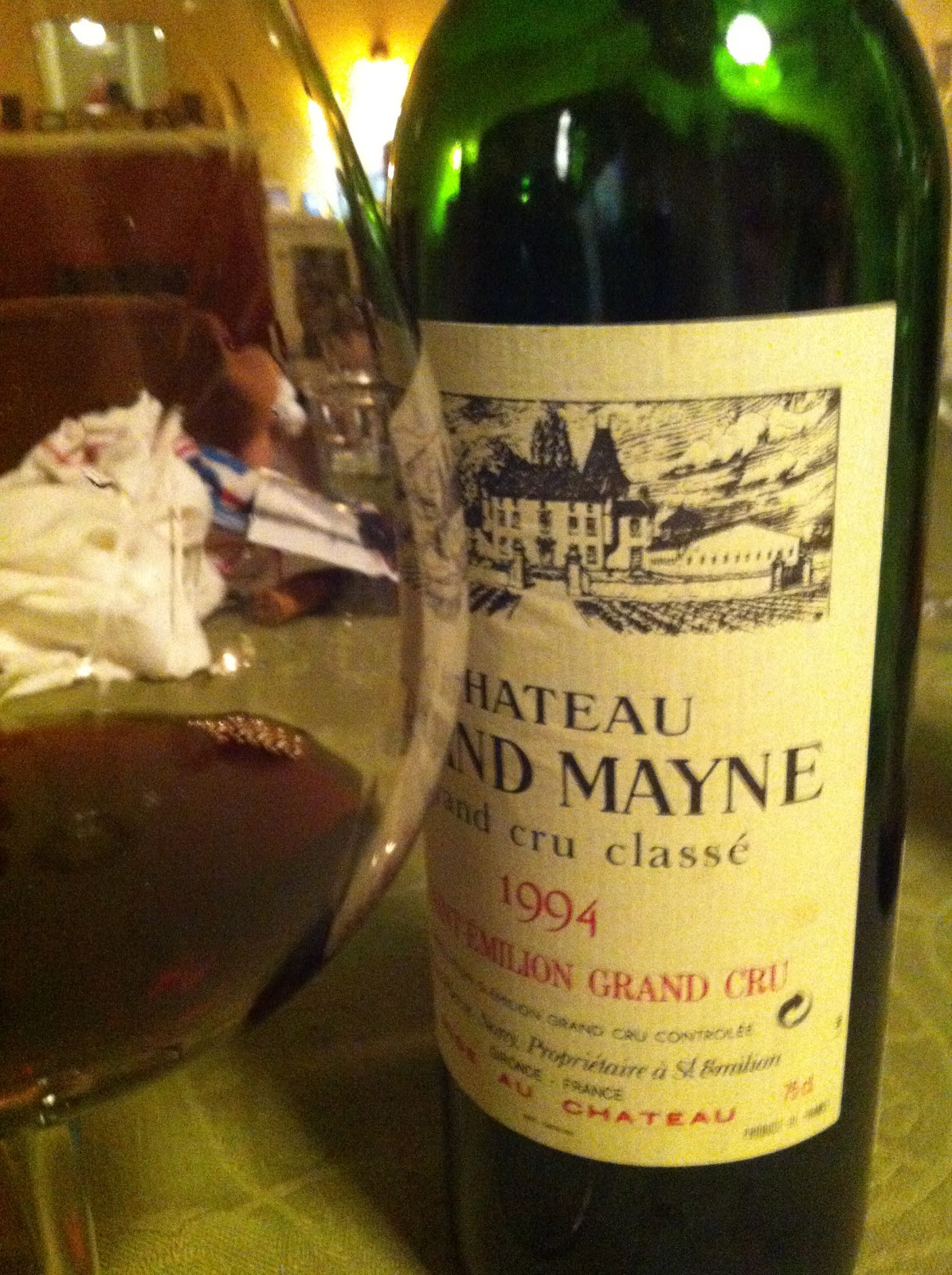
The second dinner wine was an old Thanksgiving favorite, the 1994 Ch. Grand Mayne St. Emilion. This bottle came with us from California, the last of a purchased from the Wine House in San Francisco back in the late '90s. I remember opening one with Thanksgiving then, and again in our first year in Portland with my brother and another old friend visiting. I lost track of the others but knew the last bottle would fall on Thanksgiving. Mature, gravelly red fruit, gently oaky, delicious claret and an easy match yet again with the range of flavors on our table. What a lovely last taste of this wine.


Thanksgiving is a time for the classics, so we had Sauternes for dessert. Here, the second wine of Suduiraut, the 2005 Castelnaut Sauternes. I love this label for good value. The wine tasted golden, with sweet but balanced flavors, lots of figgy botrytis notes and good length. Sometimes lesser Sauternes are too bitter or sweet. Not this. Must find more.

A guest posted a picture of a few of these bottles on the table, quipping something to the effect of must be a winemaker's house. What can I say. This is all my way of showing thanks.

November 27, 2012

Night

I'm a night owl. It's surely from my mother. These days she retires early but in her prime she would be up well past my father's old 9:30ish bedtime. It's the same with me and this harvest it all sort of hit me at once how much I want and need the night.

For little kids, the night is essentially off limits. It's dark. It's late. It's many things and it seems none of them are much good for kids. I never liked that when I was young, like staring out a window on a rainy day thinking...someday.

Of course, there's Halloween, which might be my favorite night. Not for the costumes, though I admire a crafty costume maker. I'm just not a dress up guy (dealbreaker?). And not for the candy, which is great of course and my kids love the newspaper's candy bowl feature each October. Sure, it's crazy good to have perfect strangers give you free candy all night long. But kids can find candy any time. At least I could.

No, for me I now realize it was all about the night, as if day were simple land but night something different, under the sea, an unknown world beginning to reveal itself. I loved it, roaming with friends, seeing all the common places without the color of day or people or cars or everything else that should have been there. Should, if all you knew was the day time.

As I got older, regular day activities took on new life at night. My friends and I liked to night hike in the local hills, letting our eyes adjust to the dark and walking in moonlight like we were characters in fantasy books we loved.

Then I read about night surfing, how you could have just enough light from pier lights to surf after dark. It was cool, though the light was good only on the pier side and the rest of the ocean was creepy and dark. Just what I was looking for at 17, not so much now to be honest.

The dark forced you to pay closer attention, to slow down a bit or see things in shadows that you might ordinarily miss. And I loved it all, the quiet, the solitude, like our night adventures were extra time that no one was counting or waiting on, time that was all mine.

Those night adventures continued. There was the trip to Manhattan many years back roaming the streets all night before a far-too-early flight. Or rambles through European cities late at night when the trains had stopped running and I had no money for a cab. I'd just walk and end up seeing things you never see during the day, even if it was nothing at all. Think of the novelty of being able to lie down in an empty street, what during the day was a busy road. At night all the rules were different, as if words suddenly all had different meanings.

It's funny, just as you don't see little kids out at night much, you don't see older people. You don't see much of anyone, sure, but if you do see people, they're typically younger adults. Older people are home, in bed, too cold and tired to go out at night.

That better not be me, or at least it better take a while yet before I have to give up the night. Yet there aren't the opportunities to go out at night like there used to be. Not to clubs or like that. Just for a walk, a bike ride, a hike maybe, anything, just to be out long after the town is asleep. There's something special in that.

But what do I have? Harvest, where there's a ton of work to do in a relatively short time, where I'm in a facility full of other people wanting to use the same space and equipment as I do, where I have a day job, and where I just sometimes want some quiet to listen to music that won't make it over the din of winery compressors and other machinery.

I did plenty of work during the days and evenings, and my colleagues in the new winery are terrific. But I I found myself working especially late this harvest, watching my colleagues peeling away through the night as the city itself turned out the lights, leaving me alone. Alone to slow down, to pay closer attention, to listen and, as you might imagine, to think. There's so much happening during harvest and everything to think about, yet we often don't have the time to think. There's too much to do.

In the night, I did my punch downs, cleaned barrels, drained fermenters, washed out dirty fermenters, squeegeed the floor, you name it, I did it. I listened to my music, looking for a harvest soundtrack, my night music. There were some old favorites like Elvis and the Brodskys, but newer things too, like Robert Francis, especially his song Tunnels. Or Wilco's last record, The Whole Love, which absolutely destroys me, especially Black Moon. It's so good. And Birdy's cover of 1901, turning what might be a love song into an elegy, appropriately.

Somewhere between 1 and 3am I'd wrap things up. This wasn't every night of course, but several through the harvest. The winery dark and silent, alarm on and door locked, pushing me out into the emptiness of Division Street (in my memory it's always raining). Then maybe I'd go to Potato Champion for a long past midnight snack, or just home through the deserted streets, thinking of all so many things, what I have and what I want, need. What is and what probably will never be.

I have many, many things. But this harvest I got back something I missed and never understood so well. I have the night.

November 15, 2012

Come taste wine at our Urban Thanksgiving this weekend

If you're in Portland this weekend, come taste my new Vincent Wine Company wines at the SE Wine Collective.

All four of us in the facility - Vincent, Division, Helioterra and Bow and Arrow - are pouring and selling our newest wines. We're calling it Urban Thanksgiving.

Come taste, enjoy yourself and buy some wine for the holidays before you go. We'll have everything for sale.

Urban Thanksgiving details:
SE Wine Collective, 2425 SE 35th Place at Division in Potland
Saturday and Sunday, November 18 and 19, noon-5pm each day

Tasting fee $15

November 05, 2012

Harvest wrap

November's here and with it the end of the grape harvest. This year we brought in more than nine tons of mostly Pinot Noir grapes from five different vineyards. Now all the juice from that fruit is fermented into wine and safely in barrel, where it will age over the coming year.

Never mind the two barrels of Chardonnay - our first white - that aren't anywhere close to being done fermenting. That's just fine. With reds, we crush the grapes and let things ferment for a few weeks. Then it's time to drain off the new wine, press the skins to get every last drop and put everything in barrel. But with whites, we press the grapes right away and ferment the juice by itself in barrels, ideally over several weeks and even months. With reds, fermentation is relatively quick. With whites, it can (and should) take time. So we'll let that Chard go for a while and see what we get. Think art, science and luck.

Everyone always asks - how was this year? And I'm delighted to say that several people have already heard this was a great year, nearly perfect even. No, that was last year. Nothing we want to go through again, with a very late harvest in unexpectedly dry and mild conditions, but one for the ages. One you can never take for granted. One I trust will reveal itself in time, the wines still so young but so full of potential.

Of course, years like 2011 produce wines I love. Lithe, bright, full of energy, life giving. Years like 2012, with a historically dry growing season and harvest time heat and wind, make lithe, bright and energetic a bit challenging. The silver lining - more people still seem to like richer, fuller wines. If that's you, 2012 should be stellar.

In 2012, my goal as a winemaker was opulence mitigation (stealing a line from a friend). That meant grapes picked while they still had good amounts of acidity to give the wines life. Or fermentations drawn out over a three weeks to produce a broad range of aromas and flavors. And infrequent punch downs to make sure we don't overwork the wines, overmixing things like kneading a dough too much and making tough bread. Riper years like 2012 provide lots of flavor and color in the wines. My goal has been to not push things further still, to preserve the elegance of Pinot Noir while knowing confidently that everything the grapes have will make it into the wine, even with a very gentle touch in the winery.

Sure enough, I have stacks of barrels full of deeply colored, rich but structured wines ready for a winter hibernation. And shouldn't we all be? Harvest is a maddeningly hectic time of decisions and second guessing, organization and luck, hard work and moments of sheer joy. Now that it's done, I want to go somewhere remote and sleep. And sleep. All the way until spring.


October 20, 2012

The dog days of harvest

We're three weeks into harvest and it feels like summer in August. I don't mean it's warm, no, autumn is clearly here. It's just that some things are incredibly good. Some things are getting a bit old. And some things are sweeter as the season's days slowly start drawing to a close. Just like that August feeling, when you're mixed on the passing of time.

All the fruit for my winery is in for the season. I figure I'll have around 20 barrels of Pinot Noir in addition to the two barrels of Chardonnay, which incidentally was actively fermenting on its own in barrel as well as in a couple glass carboys of extra wine that I have. Nice to see foam on the surface of the juice. Smells clean and fresh. I can't wait to have my first commercially available white wine.

Meanwhile, my six fermentors of red wine have been similarly native and active. I don't add yeast to the grapes, instead letting fermentation spontaneously occur. It's never failed. This year the ferments have been a little too vigorous. I found it interesting to hear a colleague suggest the ferments are faster with higher pHs in the juice, meaning the yeast are happier in a lower acid solution. Makes sense. One fermentor of Armstrong Vineyard is done but I'm letting it hang around for a few days while two others from Armstrong finish up. I'll press them together.

The three others are at or just past the peak of fermentation. After we mostly destem the grapes, we let them sit untouched for several days until the native yeasts build in number. Then once the fermentor is putting off enough carbon dioxide to really notice, we punch down the fermentors once a day, twice if the temperature gets a little high. Punching down meaning mixing the grapes skins and juice around to release CO2 and heat and keep the top of the mixture fresh and clean.

I'm cautiously optmistic for the wines from 2012. It's too early to say how they will be, but the first finished fermentor is nice, with good density to the flavors and nice texture from the skins. I do know that I'll be really glad to drain and press all these fermentors, then clean and fill all my barrels in the following few days. At that point, I'll be done with harvest. And that's going to be in about ten days.

I love harvest, but that's something that has taken time to set in with me. I can't wait until it's done each year, but I'm working like a dog and I've found I enjoy it.

October 11, 2012

Harvest continues

I admit it. I wrote off the SF Giants in my last post. Now they've done the unthinkable and beaten the Reds three games in a row to take their series. According to Giantdynamics, harvest continues.

It turns out that all my Pinot Noir is already in the winery. I had thought the last of it would come in Wednesday, the day I supposed would be the end of the Giants season. Instead, conditions allowed for everything remaining to come in Monday, which worked out wonderfully.

So I'm all in, right? Wrong. I'm making a small amount of Chardonnay this year and that's coming in tomorrow. I'm getting two barrels of chard juice from another winery, just enough to play with for the winter. I've made Chardonnay before but not for a while and not for my commercial label. I'm curious to work with it.

What's in the winery, you might wonder? Six 1.5 ton fermentors full of Oregon Pinot Noir. Three of the bins are from various blocks in Armstrong Vineyard, from Ribbon Ridge. The 115 came in on Oct 2, then the 667 and Pommard came in Oct 6. Brix was a bit high here and acid a touch low, but the ripeness is terrific. It's way too early to tell, but I'd guess the wine here ends up brooding and rich.

My other three fermentors are one each from three different sites in the Eola Hills. All of these grapes came in October 8. Zenith was also a bit ripe and lower in acid than I'd like. Bjornson from higher up in the hills had similar ripeness but stronger natural acidity. And my newest site, Crowley Station, showed the cool west side of the Eola Hills with just 23 brix and 3.35 pH. Fairly ripe in a less warm year but downright modest this year. I'm excited.

At this point, only the Armstrong 115 has begun to ferment. I did 17% whole cluster in that bin, my first experiment with fermenting intact grape clusters amid the crushed grapes and juice. The others are just hanging out in various states of pre-fermentation purgatory, the waiting place.

Lately there's a nice lull in harvest, as a friend put it today. The weather looks grim for the next several days. Glad I just about have everything picked. And Giantdynamics be damned. Here's hoping the Giants can continue their dominance., because I hope the Giants run continues long after all the grapes are picked. Sometimes you have to deviate from the plan.

October 07, 2012

October returns

It's October again and harvest is on. Already I have half my Pinot Noir in the winery, with the rest coming Monday and Wednesday. But more on that later. First I need to look back a bit, in wine and baseball.

I wrote earlier this year about October 7, 2001, when I first made my own wine. I suppose this could be the eleventh birthday of Vincent Wine Company. It was the final day of the San Francisco Giants season and began my pseudo-scientific theory of Giantdynamics where grape picking should happen on the last day of the Giants' season. I haven't figured out if that day should be the start of picking, or the end, or the height, or just a day you want to make sure you bring in grapes.

Where did this theory come from? 2002. Giantdynamics seemed to happen by accident in 2001, then history repeated itself in 2002 and I saw a pattern. Only, I found myself picking on the final day of the infamous 2002 World Series, when the Giants lost Game 7 and the Series after leading big and losing Game 6 the night before.

This was my heartbreaking moment in baseball, as a fan anyway. I grew up an LA Dodger fan in the 1970s and 1980s. Who was my favorite Dodger? Dusty Baker, the same Johnnie "Dusty" Baker who managed the Giants in 2002, long after my conversion to the SF club. I loved it. My favorite Dodger, my original "guy," Dusty managed my favorite team.

Only Baker went to the mound in the 7th inning of Game 6 in 2002 and took out a dominant Russ Ortiz, and HE GAVE ORTIZ THE GAME BALL! I don't normally say this kind of thing, but that was an omen. That was a move against all that could possibly be good. I screamed at the tv "No! What are you doing??" Obviously it had no effect. The game wasn't over, far from it. The 5-0 lead quickly became a 6-5 loss, and the next day I picked grapes. And the Giants season ended.

So what are Giantdynamics? Essentially, good Giant seasons might be consistent with late harvests. Think 2002 and 2010. With the Giants playing late into October, so the grapes may have to wait. Then there are years like this year, a good to great year but one that is rapidly ending. Hot weather late in the growing season has rushed the onset of harvest. Meanwhile, the Giants easily made the playoffs only to be sitting down 0-2 in a best of 5 series against the Reds. And who's managing the Reds these days. My guy. Johnnie "Dusty" Baker, who somehow ended up in Cincy.

So I'm picking Monday and Wednesday this week. Looks like Wednesday would be Game 4 in the series, if it goes that far. I'm guessing it does, only to end that night, with all the grapes just in the barn and everything right in the realm of Giantdynamics.

October 01, 2012

Sauvage at Fausse Piste

After my new wine release event at the new SE Wine Collective the other day, a great friend from out of town and I went to Sauvage for incredibly good food and interesting wine, meeting up with his sister for a while. We managed to end up in the back with Jesse, where he's busy making his well regarded Fausse Piste wines from the 2012 harvest.

First Sauvage. If you haven't been here, go. Now. I'd heard good things from very reliable sources, and they remain reliable. We had a variety of dishes like wonderfully fresh beet salad, top quality oysters, the most tender boar ribs ever, pheasant, lentils Le Puy, all incredibly good.

Then there is the wine list. Fifty selections, all well picked, all available by the glass, all amazingly priced. Oysters? How about Domaine de la Pepiere Muscadet? For $5 a glass. How about meaty Cotes du Rhone from Eric Texier for just $9 a glass? It was great with the ribs. This place is a new favorite, not just for the prices. It's simply exactly what a restaurant should be, serving top quality food.

So Jesse Skiles is a chef and is the one behind Sauvage. He's also a winemaker of his label Fausse Piste, literally in the back of the house. I'd seen Jesse earlier at our winery, and sure enough he came by his place later to check on his ferementers. We tasted from a few, lots of whole cluster syrah from Washington picked at lower sugars than most, with good natural acidity.

Then Jesse showed us his skin fermented viognier, a few fermenters worth, that was exotic and appropriately structured. He's taking a very low intervention approach with everything he's doing and the results are delicious. I'm really excited he's now making his wines in Portland.

A restaurant and winery at SE 5th and Ash in Portland. You should definitely check this place out.

September 27, 2012

Harvest 2012 begins

It's been a long year since the last grape harvest, incredibly challenging but as far as wine goes, everything I might have hoped it would be if you spoke with me a year ago. At the time I was still selling my first vintage of Oregon Pinot Noir, from 2009, and I continued to sell that wine for more than a year from original release. Sales were steady but just not fast. I guess everything you hear about the wine business is true. It's not easy.

But I took heart in a friend's words predicting that year two would be much better, as things gained momentum, as I continued to work hard and tried to remain charming, sincerely so of course. Those words proved true and the 2010s sold in half the time as the 2009s, and the reality that this project might really be working began to sink in.

Now it's late September again and I'm releasing the newest wines, my 2011s, after several months of being sold out of the prior vintage. In truth, the secret to my success is to not make too much wine. Still, it's interesting how that prediction about year two proved so true. I think about it a lot.

And now my fourth harvest as a commercial wine producer approaches. It wasn't long ago that I was making wine in my garage, opening the door once a year to let friends, neighbors, even blog readers come by and try my home made (but I believe commercial quality) wines. I moved out of the garage and into a commercial facility in 2009. This fall I've moved the operation to the new Southeast Wine Collective on SE Division and 35th in Portland. Stop by the tasting room if you're in the area. It's gorgeous.

If you're in the area this weekend, I'm holding a public tasting and sales event at the new winery, from 1-5pm this Saturday. There is no charge, but we will have all the wines for sale if you're interested. I'm sincere though in saying that there is no expectation to buy. Come see the new winery and taste my newest wines. We even have a garage door entrance just like the old days here at the house in NE Portland.

And if you're in the area next Tuesday, the plan is to harvest the first small amount of Pinot Noir from the 2012 vintage. Fruit should be coming in over the next few weeks but it's always exciting to get started. Being in town, we're particularly convenient for those interested in volunteering to help sort grapes on days we're bringing in fruit. Let me know by commenting or email me. We'd love to have you.

And if you're not local but want to follow the progress of harvest, I'll do my best to update things here. I'm busier than ever but committed to blogging the continuing saga of this crazy wine business. Read the archives to see me as a greenhorn intern back in 2005, when this site began, and follow everything to now. We're up to about 600 cases of Vincent Wine Company this fall, with plans to keep growing. It all started here, so thanks for reading and please keep coming back.

September 16, 2012

Harvest approaches in the northern Willamette Valley

Sunday's no day of rest around here, especially mid-September when the weather is still warm (almost hot) and the grapes in the northern Willamette Valley are nearing harvest. Instead of a lazy day watching football on the couch (that was tonight, and the dominant SF 49ers were worth every moment), I went with a winemaker friend to several vineyards around our area that we work with. We walked rows, tasted fruit, picked individual berries to do quick sugar tests to see about ripeness, and generally shot the shit about what we saw and tasted and what we think will happen with the coming harvest.

The highlights? Ripeness is coming on fast, too fast I fear given a long dry summer that's not letting up any time soon. Instead of 80s and sunny, I could really go for some 60s and even a little wet, just to water the vines a bit. This late in the season it's normal to see some stress in the plants (locals, check your gardens and tell me if the tomato plants looks as vibrant as they did in July - didn't think so). A little water from the skies would be lovely. Not so much that we get rot or dilute flavors, rather just enough to slow the vines down a bit and draw out ripening.

Are things really alarming? Not at all. Every year around this time it's common to get a little nervous about all the harvest work we're facing. And if it's not too warm, it's too cold, or too wet or too dry or too perfect even and that can't last. No matter what, wine makers fret about stuff, so here I am. Really, things look great. But what else would we do if we didn't fret and gnash teeth about everything?

Armstrong Vineyard on Ribbon Ridge is the furthest ahead of my Vincent Wine Company sites. Lower leaves are yellowing as the canopy ages and ripening approaches. Berry samples in the 667 and 115 clone blocks were 20.3 and 20.6 brix, respectively. That's the measure of the sugar percentage in the grapes. Ideal is around 22 to 23 in my book, some want things higher (or much higher). A good rule of thumb is that you'll gain one brix a week, so we're a couple weeks out from picking. However, that's a very general average. Hot weather can accelerate ripening, dramatically so. Cold weather can essentially stop sugar accumulation. Rain can even knock sugar levels down through simple dilution. But given the average, I think we'll pick in two weeks. That means I better get a lot of stuff ready between now and then. I'm very excited about the new winery, but that adds some complexity. Imagine throwing a party in a brand new house. How can you help the guests when you barely know where everything is. We'll figure it out.

Moving south to the Eola Hills, Bjornson Vineyard was happily further behind. It's a slightly cooler area (little differences can affect wine dramatically, do note). It's also a bit higher in elevation. I'd usually expect picking dates at Bjornson to be a week or two behind Armstrong. And that's great. We don't want all the fruit to ripen at the same time. It's like a restaurant having to serve all the night's meals at once. Instead, it's nice to have a few weeks of harvest time so you're bringing in fruit gradually, perhaps even barreling down wine from early picks before the last grapes are in. Nice to use a given fermenter more than once in a season!

Then Zenith Vineyard, lower in elevation than Bjornson and usually a bit earlier to ripen but not a early as Armstrong (we did pick Zenith and Armstrong on the same date last year, but that was an unusual year). Zenith is a little unusual this year, with some lighter colored berries still that a few more days of heat will likely darken. As with Bjornson, things at Zenith were obviously not so close to picking, and that's great. We had flowering a bit late this year, and because we want the fruit to have good "hang time" from the day it's set from flower to berry, until the day it's picked, I'm happy to see the grapes take their time to ripen.

So how did things taste? Wine makers often talk about how flavors in the vineyard will most guide picking decisions, I'm delighted how things are progressing. Since the fruit's not "ripe" yet, obviously acids are pretty tart still (enough to remind yourself not to sample too much or you'll get an upset stomach). But what a delight to taste sweetness in the grapes, which until now are just hard, green berries throughout the summer that seem like they'll never be ready to pick. Really, flavors are tricky. Ripe grapes do "explode" with flavor in your mouth, but I think a lot of people wait for that explosion to get bigger and bigger...and the wines they end up with are similarly big. I'm looking for explosive ripeness but with the right acidity or energy to keep things fresh and brisk, not syrupy and cloying. We're making wine, not fruit juice, right? So I'll keep tasting throughout the growing season, but really it's not about finding fruit you want to eat all day long. It's about fruit that's just getting to that point, or getting to getting to that point, so that you have fruit that's going to make great wine, not just great fruit juice.

Really, I'm more focused on the health of the vine and the grape clusters. Is there mold anywhere? No. Mildew? No. Other issues that may affect wine quality? No, everything looks great. We just need to finish things off well and I think we'll have a lovely vintage. And instead of focusing on sugar, I'm more interested in following the pH of the grapes, to find that spot just before acids drop off quickly and pH shoots up. That's the time I want to pick, really no matter where the sugars are.

Oh, and I'm going to get Pinot from one other site starting this year, Crowley Station, on the west side of the Eola Hills, not far from Zenith but just too far to get to today. It was a long enough day and the 49ers weren't going to wait for me. I'll get back there soon but I'm sure it's in the Zenith or Bjornson time frame. Nothing to think too much about yet. Really, Armstrong will be first and that's enough to get me finalizing harvest plans, cleaning equipment, etc. The rest will fall into line. Is it time yet? I can't wait.

September 13, 2012

September

Late summer returns and I find myself at once in a familiar and changing situation. First, the change, all great, great news.

My winery, Vincent Wine Company, has moved from our home of the past three years to the Southeast Wine Collective, at SE Division and 35th Place in Portland behind the restaurant Cibo. This new urban winery and tasting room are going to be great. I couldn't be more excited about being part of this project. The Southeast Wine Collective is the brainchild of Kate and Tom Monroe of Divison Winemaking Company, which will be in the facility along with Bow & Arrow and Helioterra Wines. We have a gorgeous tasting room that's opening later this month and we're definitely going to bring wine and wine making closer to Portlanders and travelers alike. I'm so glad to have a place to call home, and a tasting room where people can try my wines. It may not sound like much but it's something. Something to celebrate, for sure.

And, I once again have wine to sell. After selling out of my 2010s earlier this year, it's been odd to not have wine to sell, not to mention not having to sell wine. It's been kind of nice actually. I've just had to make wine, and yes there has been other business to attend to and my Guild Winemakers project keeps me incredibly busy in what free time I have. Don't forget my day job. So you can understand how a break in the day to day selling of bottles and cases of wine was rather nice.

At this point, I'm only selling the 2011s to my mailing list members. It my annual first offering at the best prices of the year, including wines that may not make it to retail. That offer ends September 28, then the next day -- September 29 -- I'm having tasting and sales event at the new winery, SE Division at 35th Place, 1-5pm. Helioterra will also be pouring and the winery tasting room will be open as usual. Should be a great time.

After that I'll be getting bottles to local shops and restaurants again, though sooner than that I'm heading back to New York for a seminar and trade tasting my distributor is doing with another small importer/distributor. This is the first time I've been squeezing in a sales trip before harvest. It's the start of many I imagine (and hope, for my own success).

With all the change and newness, there's a familiar sense in the air. The days are quickly growing shorter, some mornings surprisingly crisp. It happens this way every year, but the feeling is always so new again, so fresh, like we're reliving something from Septembers past. Already I've had that sense of autumn from growing up in LA, a cool, dry day with long shadows but little else to suggest fall, which you might get around Thanksgiving but comes here in mid-September or so. Not really autumn, but something I had there that seems to pass through this town too.

In Portland, that feeling has come to mean something new for me. Harvest. And it feels great this year. My first grapes will come in by the end of September, maybe the first week of October. In the new winery, in a new neighborhood, with the same old me. I can't wait.

August 27, 2012

An old friend returns

Our friend Tim (Teeem!) from Seattle is in town for a bike mechanic certification program. He's a great guy whom we've known for years, a wedding guest even, one of a rarefied number. He also enjoys a little red wine and eating lots of meat. It's been nice to have him stay.

A few nights ago, I thought it was time to break out the 2004 Trignon Gigondas, which I bought with Tim several years ago on a family visit to Seattle. We had gone to a local wine shop to look around and I saw the Trignon. Notice the price tag, clearly a mistake at $13. Since when has Gigondas, at least decent Gigondas, cost that little? In my naivete, I mentioned to a clerk that the price seemed too low, and what was the response?

Ehem.

"Um, no, that's the correct price."

I persisted, surprised, as if milk were $.99 a gallon. "Really? I haven't seen Gigondas that cheap in years."

"Well, it's not mismarked. That's the correct price."

Um, ok. It wasn't, it still isn't, but I tried. So I bought it and saved a bottle until now, five or six years later.

So how was it? Pretty fantastic. Still fresh but maturing, in what us wine geeks like to say is a "really good place." Also not bretty, as I remember the' 95 being several years back in our SF days. I'm no clean wine freak, but brett influence on wine gets pretty boring after a while, like new oak. I find I open southern Rhones these days with trepidation. No worries here.

The flavors were full and juicy, with a mix of warm fruit, stones, lavender and other garrigue notes that defines excellent southern Rhone valley reds for me. I could sniff and taste a wine like this for hours, slowly, caught in a perfect moment and not willing to let go too soon. Or ever, if one could.

Randall Graham of Bonny Doon said something at the wine bloggers conference recently that's stuck in my mind. He asked what does wine show us about humanity, about beauty? And he suggested that wines that move us move us to poetic language. Not sure if that's true in my case, poetry anyway. But I know that feeling and this wine provoked it.

And at a price you can't beat.

August 26, 2012

#WBC12

Ok, finally a moment to recount the Wine Bloggers Conference 2012 that happened in Portland last weekend. I went into the event a bit skeptical about how professional the experience would be. Is it self-hatred? I'm a blogger, yet I feared that other bloggers might not be serious enough, whatever that really means. I guess I just didn't want to be part of some kind of shill fest of people looking to promote anything they could get for free, with each day devolving into a booze cruise party.

So how was it? Really good. The event attracted lots of bloggers, some more experienced and knowledgeable than others, as well as lots of other categories of industry people. Journalists, producers, publicists, vendors, and because it was in my hometown, lots of old and new friends who were a delight to spend time with.

Yes, there were sponsors providing lots of opportunities to taste their wines and otherwise hear their pitches. So what? We tried wines of Oregon, of course, and Alsace, Franciacorta, Greece, Mallorca, Sardenia, among others. Several were exceptional. Several were ordinary. All were worth my time.

I skipped the Thursday evening reception in favor of Friday's conference kickoff events at the Doubletree Hotel in Portland. There was a general tasting of wines of the world, a wistful keynote by Randall Graham, speed tasting of whites and roses (not my favorite moment to be sure), then field trips to various wine regions close to Portland. I was on the bus to Sokol Blosser winery in the Dundee Hills, where we learned about soils with Rolin Soles of Argyle and David Millman of Domaine Drouhin. Then we had a tasting in the cellar of several notable Dundee Hills wineries, more tasting outside with some delicious food from Red Hills Market and ice cream from Salt and Straw. Don't forget the beautiful scenery of the Dundee Hills, including the iconic tree pictured below that Eyrie fans might notice. Then back to the Doubletree for the sort of unfortunate night of many bottles. This was one of the weaker moments, with way too many bottles in a warm room where smaller, less formal gatherings would have been better.

Saturday saw lots of breakout sessions on topics like social media and what is wine blogging anyway. I enjoyed the learning sessions but then took advantage of Winebow's session on unusual grape varieties of the world, a blind tasting of seven wines led by Sheri Sauter Morano, MW, a terrific session host. Ever had Hondarrabi Zuri? How about Sauvignon Gris? Neither had I, knowingly anyway. Then there was an uncomfortable keynote by author Rex Pickett, who's a name dropper and terribly prone to talk about things he "can't talk about" and then keeps talking but doesn't say much and you're left wondering, what? Then more speed tasting of red wines, this more successful in content than the whites and rose. Then a break before dinner hosted and prepared by King Estate Winery. Not shabby, and I enjoyed good company at my dinner table.

I was especially impressed with the people who came to the conference. Lots of internet wine geeks from the pre-blog days, a few MWs at least, the organizer of VinItaly, you name it, I kept turning around and meeting people I was glad to meet and look forward to seeing again.

After Saturday dinner, there was more wines of the world to taste, then the official unofficial after parties in various hotel rooms. I stopped by the Chehalem Mountains Winegrowers Association tasting to say hello. Then I went to the Drink Alsatian event for the highlight of the weekend, a four year vertical of Trimbach's Clos St. Hune Rielsing. Oh my god, the '97 was magical and the others simply otherworldly. Sometimes I get jaded in the world of wine, but these wines were incredible.

Ok, that sounds like a lot of wine and it was. I spit pretty much everything until later in the evenings or at the Saturday dinner. I also didn't stay at the hotel but was smart enough to ride my bike the few minutes from my house. Two days was plenty, so I skipped the final Sunday morning events and called it a good conference. So good, I'm thinking I very well may go next year when the event is in Penticton, BC, which I happened to visit a year ago this weekend. A lovely place with special memories for me, though I won't be staying at the Holiday House.

August 16, 2012

Wine Bloggers Conference Portland

I've been wine blogging since 2005 but never really got into the whole blogging thing. You know, monetizing the site with ads and link exchanges and all that. Or going into the whole free wine solicitation thing. I've gotten a few sample bottles and books, but nothing much, and that's not what I'm really into doing.

My blog has been more a personal thing. Blogs are vain, so I initially referred to this as a vanity site, self publishing like the old vanity press days. Maybe I'm more comfortable with vanity now. I don't solicit the samples or have the ads. And I don't have an issue with baring my loosely wine-related soul on this page.

But I always knew sooner or later I ought to get a little more connected to wine blogging. Then I saw the Wine Bloggers Conference was coming to Portland this year, now this weekend. So I signed up and now I'm curious to spend my weekend in the company of other amateur writers (and a few legit ones).

My conference goals? That would require planning and a list, neither of which I do naturally. Still...
  • Meet other bloggers. If you see me, introduce yourself. 
  • Figure out why people wine blog. Is is just for the free samples? Is it ego? Is it a love of wine and this a medium to share that love?
  • Does anyone make money from ads on their sites? Don't worry, I'm not going that route. Just curious.
  • Is wine blogging serious? And what is wine blogging these days?
On that last one, there's a thread on Wine Berserkers about a producer actively avoiding professional critic reviews. Some people are critical, saying he's only doing it because he can. He's not like more people who rely on scores to sell wine. I think those people are mistaken, seeing established media as the only route to go. This in a new media forum even. The irony.

This producer isn't necessarily looking for "traditional" bloggers, if there's a blogging tradition. He's specified Cellartracker as one place he'd like see reviews, and ideally lots of them, rather than in The Wine Advocate or Burghound. Are Cellartracker users blogging? Or are blogs simply web logs with a pretty set layout and fuctionality?

I think it's more the former, so that blogging is wider reaching than many might think. And it's potentially more significant to consumers than many producers and even internet wine forum participants think.

But we'll find out more at the Wine Bloggers Conference. I'm hoping it's good and not an amateur hour shill show. And not just because I paid my money and want to learn and have fun.

Next year's event is in Penticton, BC, a place I've come to love. I wouldn't mind a reason to go back again, though I think I need to find somewhere else to stay than the Holiday House. I need to mix things up.