November 11, 2010

Nocino update

You may recall my post from July about nocino, the green walnut liqueur made in southern France and Italy and, more and more it seems, Portland, Oregon.

It all started with my friend and Guild Winemakers co-conspirator Anne Hubatch and family holding their annual nocino party on the last weekend in June. That's traditional nocino-making time, when walnuts are sizeable but still immature, the way you want them for nocino.

The Hubatch party had been featured prominently in Mix magazine in 2009, complete with instructions on making your own nocino. We were invited to this year's party but because of the crazy cold and wet spring, the walnuts weren't ready for nocino until mid-July. By then, I'd gotten my neighbor Edward's permission to harvest lots of walnuts from his front yard tree. So with a ladder and tree trimmer turned walnut harvester, I drew the attention of the kids on the block in my quest for perfectly underripe walnuts. With lots of help, I gathers several dozen and took them home to make nocino. After quartering the walnuts, I simply put them into two jugs and poured in white wine, vodka, everclear, cloves, cinnamon sticks, fresh orange peel and varying amounts of sugar as a test. The jugs were intentionally not filled all the way, then left out in the light, heat and cold to oxidize as much as possible over four months.

It's November and time to strain what's become a brackish liquid and check on progress of flavor and aroma development. I'd periodically open and close the tops of the jugs to give a sniff and to get more air in contact with the liquid, to help tame the fierce tannin from the walnuts. Thing really unripe bananas, and think of the oxidizing process as a slow cooking that helps sweeten and cure things until they are delicious. At least that's the idea. Along the way, things smelled great but quick tastes showed lots of raw tannin. I hoped time would help calm that down.

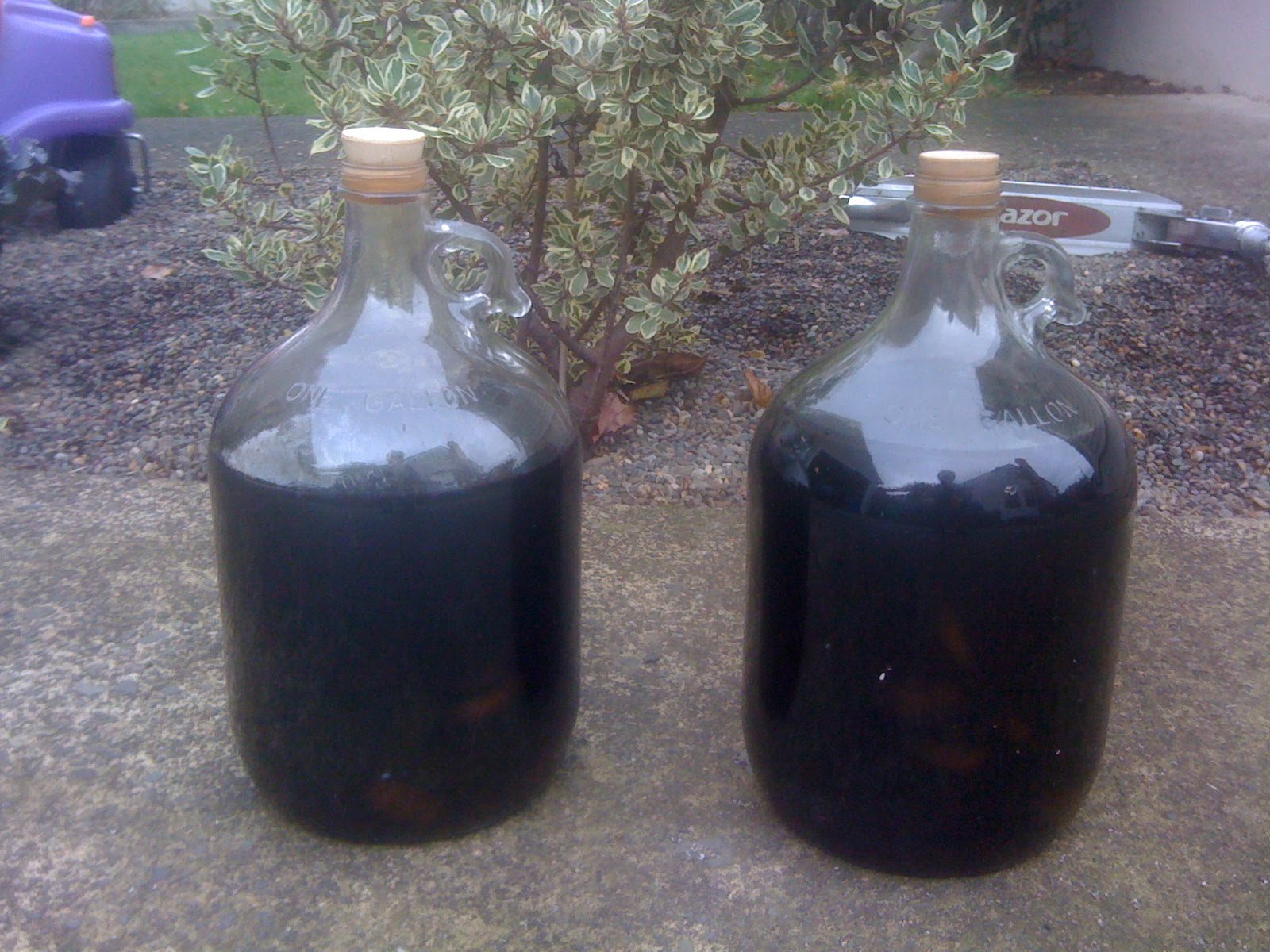
Now, I strained the nocino first through a fine mesh strainer and then again through the strainer lined with cheese cloth. I did a good job catching bits of sediment and the occasional wedge of blackened walnut, which you can see here. The fragrance of the nocino filled the garage where I was working and I couldn't wait to taste the nearly final product.

First I tried the half sugar jug, pouring a bit into a dessert wine glass and holding it outside to get a good look at the color in natural light. This sample was fairly bitter and tannic, definitely in need of either more time, more sugar, or most likely both. Then I tried the full sugar jug and it was much fuller and smoother, if a touch too sweet. I found it interesting that the full sugar batch on the right, which started out lighter presumably because there was less air in the jug (more full because of more sugar), now it's darker. Seems like the sugar caramelized to a browner color while the lower sugar jug on the left maintained more of a honey color, with some browning in the middle but noticeably less than the other.

I originally thought I'd end up bottling the two batches separately, but I found that a mix of the two samples was best of all. Now I'm thinking I'll blend them, but for now I kept things separate. Here are the two jugs of stained nocino in the middle, bracketed by the original jugs with stains on each showing the original fill levels., before I shook out the walnuts (which didn't take more than a minute for each jug). I'll let the strained nocino sit for a few more weeks to settle out more sediment, then perhaps strain again and pour into little bottles for keeping and giving. Neighbor Edward will get some, as will the Hubatch family. I'm definitely saving some for the future. I've seen that nocino can improve dramatically for a few years. But I'm sure a few other bottles will find their way into other hands. Nothing like nocino for the holidays.

November 09, 2010

Harvest 2010 wrap - part two

See part one here.

We left off at pumping the freshly crushed grape juice over the grapes skins, to aerate the "must" (what you call the unfermented, crushed grapes) and gently begin extracting color and aroma from the skins into the juice. Then our technique is to let the fermenters sit for days on end until fermentation starts naturally. Temperatures and sugar levels are checked daily, and things monitored to make sure no issues arise. Once the grapes have naturally come up in temperature by the beginning of fermentation, this year about a week later, we punch down the cap of grape skins that rises up in the bin (think bread dough rising).

Once fermentation is going in earnest, the cap rises nearly to the top of the fermenter and things warm up significantly. This year temperatures rise to the low 90sF. Here you can see the thermometer reading about 84F.

The view from above a bin, the punchdown tool in the fermenting must and the telltale visual of fermentation, foam, rising through the hole made in the cap. The cap of grape skins can be a foot thick or more in these 1.5 ton fermenters, and they are tough to punch through at the peak of fermentation. As things wind down, the cap softens and things are easier to mix.

Here's Armstrong grower Doug Ackerman lending a hand with the punchdown tool.

Things are more than busy in any winery at harvest time. Still, there are moments of reflection, especially on a beautiful evening when you know you'll be working late.

And things frequently go late. Bin after bin of grapes to be sorted. Then everything to clean up, only to get dirty again the next day.

Mornings are the time to check the fermenters, using a strainer to get new wine to test for sugar level, temperature and acidity. And senory evaluation, meaning smelling, tasting and of course spitting, to see how much tannin is in the wine, among other things to watch for.

Here's a beautiful shot of pinot blanc destined for another label fermenting, the bubbles of carbon dioxide sparkling like stars. Stars that smell like guava. Space like that would be nice, no?

When fermentation is done, it's time to drain fermenters. Here is one of the Armstrong bins three weeks after picking and processing. Using a sieve, the new wine is pumped into another bin to settle for a few days, the grape skins scooped out to smaller bins that can be dumped into the press.

Here's that wine being pumped into the settling bin.

Here are the grape skins dumped by forklift into the press.

About 80% of red wine from a fermenter is "free run," meaning it is liquid you can draw off the skins without any work. The other 20% is "press wine" that comes from squeezing the skins. Here's the press pan full of press wine, much cloudier than the free run wine for all the solids pressed out along with the wine.

After a few days of settling, the final task is putting the new wine in barrels. Once everything is in barrel, harvest is essentially done. Here's a tag on one of the iron barrel racks that needed some repainting to protect against rust before barrel filling.

The barrels get cleaned and filled with wine, stacked by fork lift and stored for a year or more of ageing. Harvest is now done, and never a moment too soon. It's November and time to begin looking forward to the coming year.

November 08, 2010

Harvest 2010 wrap - part one

We're back after a busy month bringing in grapes and making new wine. Rather than detail the events just in words, let's try a more image-based approach, starting back in the middle of the growing season.

Here were are in late July at Armstrong vineyard on Ribbon Ridge, well past flowering so that the grape vines have set their crop but well before veraison where the grapes turn color and begin to ripen. All looks good, as we'll see, things continue to go well despite strange spring, summer and fall weather that makes even jaded Oregonians think twice. Cold and wet in spring. Mild in the summer. Ultimately perfect in the fall.

Speaking of perfect, here's my bride at Armstrong on that gorgeous late July night, walking in the paddock with our daughter, chasing neighbor horses. Life is good on Ribbon Ridge.

Our son Martin in the vines this same night. Looks like a future Oregonian vineyard hand and cellar worker if you ask me, not that I'm pushing the kid too hard.

Meanwhile, down at Zenith Vineyard the Pommard clone Pinot Noir in Block 6G is looking good in mid-September. Leaves completely pulled to promote good airflow with our cool and occasionally downright humid late summer conditions. Veraison has come and gone but harvest is still weeks away yet.

Up at Armstrong, the grapes are looking better and better. You can even see a little dehydration, not something we look for but something that indicates the exceptional ripeness this vineyard achieved in what was a challenging year in many sites.

Daughter Dolores in the vines at Armstrong, late summer. We are on a vineyard walk talking about ripeness, what it looks, feels and tastes like. She is pretty interested. One of the highlights of my summer for sure.

Yours truly, in a rare appearance on these pages. Enough.

Early October now at Zenith. Lower leaves starting to yellow, fruit more than completely exposed but looking fabulous. Tim Ramey and company at Zenith do an incredible job.

That same day, up at Armstrong where leaves in the 667 block are also starting to turn. I pull cluster samples at both sites to see for myself how things measure out and taste.

Back at the winery, those samples provide the first look at 2010. Juice coloring up pretty quickly, definitely a sign of ripeness. Flavors sweet with strong acidity. Sugars higher than expected and the call is to pick two days later at Armstrong, the following week at Zenith.

That means it's time to wash picking bins. Harvest is on.

Friday morning, October 8 at Armstrong vineyard for the first harvest off this site planted in 2007. The crew works fast and clears all 12+ acres in half a day. Amazing work.

The sun comes out after the clouds burn off, and the grapes arrive at the winery. Now the real work for us lazy cellar people begins. Meanwhile the pickers are undoubtedly drinking beer. Well earned.

Jennifer on the sorting line, smiling because this is just the beginning. And because this is great looking fruit. After several hours of sorting through each cluster, it's not so fun. But she even looks great then too.

The final shot of part one - a pump over of the newly crushed grapes to mix them well before they sit until fermentation begins naturally. That means no punching or pumping for a week or more. Nothing until things get going really well, then twice daily punchdowns to mix things well and aerate the fermenting grapes. We'll see next time how things proceed.

October 25, 2010

Art, science and luck - harvest 2010

A friend gave me this terrific phrase that pretty much sums up my view of making wine - art, science, luck. It doesn't just have the right elements. It has them in order.

Great wine is an expression of specific grapes, of a place and a season. It is an artistic expression, and not simply that of the winemaker. Wine as we know it is not natural without human intervention. Still, humans are a part of nature and our role in guiding grapes to reflect what we at least perceive to be their nature is fundamental to what's interesting and artful in wine. Anyone can ferment something and make it drinkable. I believe the art of making great wine is about helping the uniqueness of a specific lot of grapes become real and beautiful. Something you can smell and taste.

Of course, there is science. We study the biology and chemistry of soil, plants and fruit in the vineyard. Then we take the grapes at harvest and analyze their components, perhaps intervening to preserve the integrity of what's there. We monitor sugar, acidity levels and temperature throughout fermentation, observing smells, tastes and textures along the way. For me, the goal of science is to understand what's present and what's happening, all with the intent of allowing what's there to best reveal itself in the finished wine.

And there's luck. Luck implies something happening that won't usually happen, and great wine is undoubtedly the product of luck. Luck in the growing season and luck in the winery, where things that you've done before, perhaps after a season that might not have been entirely unprecedented, somehow delivers something truly exceptional. Doesn't this happen in so many walks of life? From sports championships to a great novel, how many times do people produce something extraordinary and spend the rest of their time trying to recapture that result?

But luck has another side. My dad, like many dads I suppose, used to say that luck happened to people who worked hard. Luck in this way being fortune, something that might be repeatable with a certain diligence. I think of the best improvisational musicians. They study and practice, tune their instruments and set things just right, then let go and allow fortune to reveal something great. The result is usually not something anyone had in mind, which is the point, as if there's a combination of artistry in the musician and the music itself, so that the musician is channeling or funneling something more essential than he or she would have consciously delivered. How many times do we hear winemakers talk about talking great grapes and simply trying to not screw things up? It's really true.

That's winemaking to me. You go into it looking for expression. That's the point. You are diligent about analysis and technique, with the goal of preserving that expression. You then let go to allow something greater than you to happen. So, harvest 2010 has been about harvesting, sorting and destemming, adding some sulfur to preserve integrity, and largely letting the grapes ferment without interference. Each fermenter was mixed once, then left alone for a week or more until it became active, then monitored for a complete fermentation.

The goal isn't to say this is the right or best way to make wine. Rather, to see if the result will be reflective of the grapes, their place and season. And perhaps something lucky, either chance or fortune, will come from it. At the least it should be unique. So far, I think it's a mix of both. I'm excited for what harvest 2010 in the northern Willamette Valley is producing. Stay tuned as the new wines age through the winter and spring.

October 19, 2010

Old vine pinot at Medici vineyard

I spent this glorious day at Medici Vineyard helping friends field sort a few tons of Pinot noir from 36 year old own-rooted Pommard clone vines. Medici is high up in the Chehalem Mountains, off Bell Road due north of Newberg. If you're in the area and see a steep vineyard high up on the hills, that's Medici. This shot is from the top of the vineyard, at 800 feet looking west to the Dundee Hills. It ended up around 70F with a light breeze, shirt sleeve weather in later October. Unbelievable.

I think of today as a field trip, to taste and see grapes in a vineyard I've never before visited, then helping with the processing at a winery in the McMinnville wine ghetto. There's nothing like getting out of your cocoon to see how other people think about and work harvest. What did I learn? Nothing major, just little things about vine health, grape maturity, sorting technique and general approach to fermentation (hands off). The biggest thing might have been how comfortable I finally am with all the usual duties of bringing in and processing fruit. It's not rocket science, but there's a difference between following along and staying out of the way and knowing what needs to be done and when.

I guess that's a long way of saying I actually helped out and it felt good, especially seeing friends get their first lot of grapes for a new project. Meanwhile, things are cooking back here in Portland. All of my own fruit is in and things look great. More on that soon. I'm late for an appointment with my dreams.

October 15, 2010

2006 Reverdito Barolo - Excellent Deal in Portland

Readers know I'm a sucker for a great deal, or at least the idea of a great deal. But really, what would you say if I told you I'd found a Barolo under $20? You'd dismiss me with a "stop buying your wine at Trader Joe's." Back away from some industrial shell of such a noble DOCG.

And you'd likely be right. Trader Joe's is full of low budget and low value Amarone and Barbaresco, appellations that typically command high prices and promise incredible wine experiences. So how is this possible? Barolo, the king of nebbiolo from Italy's Piedmont region, for less that $20? That's a normal price for regional nebbiolo these days. How could you possibly get Barolo for such a price, much less something that's not only better than those nebbioli but worthy of the Barolo name much less any of your money?

Enter the 2006 Reverdito Barolo, in the local Portland market from Zancanella Importing for around $19. Reverdito is a smaller producer of Dolcetto, Barbera and Nebbiolo from the town of La Morra. Usually their wines offer good value, with notable prices on their Codane and Moncucco Barolo in the $28 to $35 range, low for Barolo though perhaps because Zancanella imports the wines directly.

Then I was in Vinopolis recently and saw the latest Barolo for just $18.99. I had to ask shop owner Dan about the wine. He said he believed Reverdito blended all their Barolo for this vintage together in one bottling, and priced it to move. If it were as good as basic regional nebbiolo I would be happy. But tonight with homemade pizza this wine is absolutely delicious. It's rustic but powerful, not lacking stuffing for nebbiolo's classic tannin and acidity. It's dark ruby colored but translucent, still traditional with lovely dried flower, spicy cherry and tar aroma. Perhaps there's some barrique aging here, but I find nothing overtly modern here. You won't get the finesse and elegance of top producers. You will get true Barolo character and depth for a lower price than I've seen in many, many years for real Barolo.

The back label tells of the Reverdito vineyard holdings. Two acres of Dolcetto d'Alba, two of Barbera d'Alba, five of Lange Nebbiolo and eighteen acres of Barolo, all in the villages of La Morra and Serralunga d'Alba. This wouldn't matter if the wine was no good, but this is good wine, all from a very small area that I believe produces Italy's most exceptional wine. Wine like this won't make you forget the wines of Giacosa or Mascarello. However, this seems like an exceptional opportunity for authentic and delicious Barolo for the price of peanuts. For the record, Liner and Elsen also has this on the shelf and I imagine others in the area have it too. Anyone can order it from Zancanella, assuming it's still available. Barolo at this price won't last long.

October 06, 2010

Ready to pick

Got a report last night that our Ribbon Ridge site, Armstrong Vineyard, was closer than I expected to harvest. Grape sugars in the 23 range and acids in the 3.3 to 3.4 pH range, still very bright but the way I want them. I had to take the day off work and visit both of our sites, to see and taste things for myself.

First stop, Zenith in the Eola-Amity Hills. This is such a great site and I'm always happy taking the Wheatland Ferry across the Willamette to get there. Without a bridge across the rive between Newberg and Salem, we take the old car ferry, turn off the engines and glide across the water for a few minutes. It's lovely.


Then to Zenith to check out block 6-G, where I get Pommard clone Pinot noir. As I got to the ferry I received an email from vineyard owner Tim Ramey with tons of numbers for various blocks, including this one. Sugars were 21.3 and pH was a teeth-rattling 3.03. I walked the rows and took my own sample. Fruit tasted close but not quite there. Things look great so we should have no problem waiting another week, though as is the case everywhere this year, bird pressure is high. Lots of birds eating the ripening grapes.


As an aside, is this the year of the critter? Last year the fruit crops from cherries to grapes were huge. This year, the mosquitoes were rampant, the raccoons wrecking havoc in my garden, the birds everywhere, at least it seems.

Then up to Armstrong on Ribbon Ridge. Bird pressure is strong here too. Happily, we're about to pick. I took samples in all three of my blocks, clones 115, 667 and 777. Sugars had been reported in the 23 range, with pH in the 3.3 to 3.4 range. Flavors are generally great, with a few less ripe berries. That's fine. I'm not looking for huge ripeness and my readings below suggest plenty of sugar development. Acids remain bright though, which I'm excited about.


Today got up to the low 80s around the northern Willamette Valley. What an absolutely gorgeous day, nearly 15F above the norm this time of year. Certainly our last day at 80 and we'll be happy to hit 70 a couple more times. The season is nearing the end, but the grapes will hang and continue to ripen even with weather in the 60s. What we don't need is a lot of rain. Some is on the way, but apparently good weather is on tap for next week.


Back at the winery, the grapes samples I picked came out sweeter than expected. Pommard from Zenith was 22.1. From Armstrong, the 115 came in at 24.5 brix, the 777 at 24.3, and 667 at 23.8. All at or even above what I'd hope (23.5 if you're wondering). Number don't tell the whole story. Still, things are clearly ready at Armstrong and I'm excited for the vintage. You can see the juice above. Things smell and taste great.

October 04, 2010

Seattle road trip

I spent 30 hours this past weekend on the road to and from Seattle. The point was to connect with Vincent Wine Company wine buyers up that way, seeing old friends and meeting new ones. Along the way I took the opportunity to listen to some music on the drives and visit some wine shops, and one West Seattle music shop, and otherwise enjoy some solo time before the impending harvest.

Out in West Seattle, I visited West Seattle Cellars, a tight little space packed with wine and people on a Saturday afternoon. Nice to see a shop that I'd heard of for many, many years when it was owned by internet wine guy Mattman. Didn't find anything I could live without, but up the street I did luck into exactly what I wanted, a used copy of Elvis Costello's All This Useless Beauty, which I have on vinyl and love but can't easily listen to in the car. Sorry old schoolers. I broke down.

Then to Esquin where I found the first cache of 2005 Clos de la Coulee Serrant for less than $40. I guess Joly wine isn't the rage it used to be? Some other deals in this legendary Seattle store, but nothing I couldn't live without. I did grab a Joly. The up the road to the imposing Safeco Field and Qwest Field complex. And what did I see? Ha.

Look closely. That says "Portland, Oregon...Soccer City USA...2011" which is when the Portland Timbers join MLS. Yup, right in the Sounders' grill. Love it.

And what's this? I can't resist slumming it in the Grocery Outlet. Aside from some more than decent Neil Empson close outs from good Piemontese produces, there's a true GO oddity. The 2002 Jasper Hill Shiraz Georgia's Paddock for $25. Aussie cult wine, in the discount bin essentially. If you're in the area and into that kind of thing, that's a steal. Jasper Hill is one of the great Aussie producers. I grabbed one just to check it out.

Then up to Seattle Wine Storage to drop a magnum for a customer. The guy working there finds out I'm a "winemaker" and thrusts a glass of mystery wine in my face. What is it, he asks. It's hard to read, but I get to gamay. Yes. Beaujolais. Yes. Morgon. Yes. Turns out it's the 2009 Brun Morgon, and he also has the 2009 Brun Brouilly. Both excellent and probably steals for what they cost, but they came from out of state. This guy has a bad impression of the local wine market, for things like this anyway. Fair enough. I'm buying Aussie shiraz, ferchrissakes.

My drops done for today, I stop by Champion Wine to see this Euro-centric shop. It's a little warm inside, as I'd read online. But the selection is nice and I find a bottle of Marchesi di Gresy Barbaresco Martinenga Camp Gros for a nice price and buy it. Meanwhile I talk with the owner about my project and maybe plant the seed of a future buyer. We'll see.

Then I head down to Pike Place to Pike and Western. Cool to see some Oregon brethren represented but I'm more taken with the latest issue of the Oregon Wine Press that somehow is all over Seattle already. My guy Francois is on the cover. Could have been me. They wanted to feature home winemakers and I was set to be part of the story, but I'm commercial now, so they asked if I knew anyone with a photogenic set up. I know Francois, and there he is on the cover of the October issue. Nice job. Cool to see Vincent Wine Company written up on page 12 though. Check it out. Francois, Jean-Jacques from Pike and Western says hello. Hope to be on the shelf here on day.

Then to the flying fish people in the market. Why? I don't know. They just throw fish and I think it must hurt the quality of the meat, no? I guess I can't help being a tourist.

Great old friends put me up for the night, much to my wife and children's chagrin. They would have liked to be there with me. Next time. There will be a next time.

Late the next morning I set off to lunch with Thad Westhusing of the Beyond the Bottle blog. Thad and his family were terrific hosts for a lovely lunch featuring delicious 2006 Roulot Meursault and a modest bottle of my 2009 Eola-Amity Pinot Noir. The Meursault was excellent, all sea shells and lemons and nerve. My wine was showing nicely, if I may say that. Fragrant, red fruited and spicy, but not wood spicy. Honestly, this was the best showing it's had since bottling. The wine is pretty nice, I won't deny. We said goodbye with talk of connecting down here during harvest, which would be excellent. Thad, I'm holding you to that.

Then I drove east to the burbs across Lake Washington, for some deliveries and a visit to Pete's Wine Cellar in Bellevue. Honestly, not my favorite spot though they had more of that Coulee Serrant for even less than Esquin. I leave without buying, which is good because the point of the trip wasn't to buy wine. No, it was to see the city and its people, then head south to home with the sounds of Chavez Ravine in my ears, long shadows and fading cottonwoods. It's October, we're not yet picking grapes, I'm roadtripping and everything's good.

September 29, 2010

Harvest approaching

When you make wine, everybody always asks, "so, how are the grapes?" Every year there's a story to tell, and this year the story is more unusual than normal. Some years are wet, some dry, some hot, some cold, some with early bud break, some with late flowering, and so on. This year has had it all. Dry, warm winter that's typical of El Nino years in the Pacific Northwest. That meant budbreak, where the new vine shoots begin to grow in the spring, was in late March and early April, two weeks early. Everyone was concerned a late season frost would kill all those shoots, and while we got close, it never happened.

So it's an early year, right? No. After budbreak, the skies opened and the temps plummeted, with record spring rains, swollen rivers locally and instead of flowering early, we were two weeks late with flowering happening in late June into early July. Talk about reversals. Then summer came and while we had dry weather for nearly two months straight, temps only rarely turned hot. This was the bummer summer, good for those of us without a/c but bad for tomato growers and, it seemed, grape farmers. Then came September and the skies opened again. Things looked gloomy, we really needed a stretch of warm, dry weather, and wouldn't you know it. It's here. We've had days in the 70s and 80s lately with some unusual humidity that's passed, and the short and long term forecasts are very positive. All told, this was one crazy year that on the one hand I wouldn't want to repeat, but on the other I actually prefer to the torrid heat last year. Pinot noir doesn't like all that heat, and though it doesn't like cold summers, if we can keep this beautiful fall weather going, things could be at least good if not great. We'll see.

Here are some shots from recent vineyard visits, so you can see for yourself some nearly ripe fruit and leaf canopies that are still nicely green and able to turn that sunlight into grape sugars, aromas and flavors.

Pommard clone Pinot noir at Zenith vineyard last week. These grapes look great as usual, and aytpically they are more advanced then most of the other clones in the vineyard. Good this year.

The view from the southeast corner of Armstrong vineyard on Ribbon Ridge the other day. These vines are young Wadenswil plants, that might get ripe and go into one of my fermenters.

Higher up at Armstrong, some nice looking clusters, healthy, getting sweet and tasty, just needing a bit more time. Don't they just look like they'll make good wine?

The real nemesis this time of year. These trees to the north of Armstrong are positively screaming with birds, which like to eat ripe grapes. The netting is up on many vine rows but the birds are smart. They're an old sign of ripeness. When the birds eat, we're close.

In sum, things look great for Vincent Wine Company grapes in 2010. We may have the first fruit in next week or weekend. Then it's time to make wine.

September 28, 2010

Guild exposure

Very cool to wake up this morning to an article on Guild Winemakers in the Oregonian. Throughout the day the piece got picked up by places like eater.pdx and oregonbusiness, with other outlets planning articles or radio pieces. Even Jon Bonne, wine editor at the San Francisco Chronicle, tweeted "A brilliant concept ... score one for Portland" with a link to the Oregonian article. I agree. This is exactly what Portland needs, and perhaps many cities. Cooperation. Reasonably priced wine for everyday drinking. Alternative packaging. Urban wine culture. It feels right, no?

September 19, 2010

Guild Winemakers

A little news from the wine business division of elevage...

You know I've started my Vincent Wine Company label. Now I'm happy to announce my part in a new co-op wine project called Guild Winemakers. After months of planning and work behind the scenes, we're finally going live. Guild is a partnership of John Grochau of Grochau Cellars, Anne Hubatch of Helioterra Wines, me and a fourth "mystery" winemaker who needs to remain nameless for now. Our project is about many things, but foremost we are friends who all live in the city of Portland and enjoy the creative process of working together making, blending and selling wine. Our goal is to produce high quality wines of exceptional value, focusing on reds from Rhone varieties (for now) and crisp, food friendly whites.

What's different here is that we're not just bottling wines. We're also offering wines in kegs and, soon, in bag-in-box format. People are already doing this of course. But there needs to be more people packaging wine in new and different ways, reducing materials usage and keeping costs and prices down. Kegs allow restaurants to offer fresher wines by the glass without lots of waste if bottles aren't finished before going bad, and worse if the restaurant keeps pouring that stale wine. Bag-in-box format allows individuals to do the same. Of course there is lots of Guild wine available in bottles, but we want to do more and more in alternative formats. Stay tuned on that.

For me, Guild Winemakers is a great opportunity to keep growing in my wine making and wine business knowledge, and do things collectively with the group that would be more difficult if not impossible to be doing on my own. So I'm really excited to be part of it and to contribute to it.

Yesterday, we launched the first Guild wines at the joint open house for Helioterra Wines and my Vincent Wine Company label. Along with our own Pinots, we poured the Guild White Lot 1 and Guild Red Lot 1. The White is a 2009 Willamette Valley Pinot Gris, crisp and flavory, easy with or without food. The Red is a 2008 Columbia Valley blend of 67% Syrah, 25% Mourvedre and 8% Counoise. The syrah gives deep fruit and spice tones, the mourvedre and counoise adding lift and peppery notes that, when we were doing blending trials, really made a more interesting and unique wine than the syrah alone.

These Guild wines are hitting the market in the next week. We're already at work on white and red Lots 2.

September 15, 2010

2002 Clos de la Roilette Fleurie

In honor of Joe Dressner's big day, I thought it was fitting to open up one of his imports, the 2002 Clos de la Roilette Fleurie. That, and the potato leek soup Jennifer cooked up on a cool rainy Portland evening. What a dish (the soup, of course) and what a wine. Thanks Joe and company for bringing things like this to America. As I hope you can see, this eight year old bottle of cru Beaujolais came out of the cellar in perfect condition, appearing like it was bottled yesterday. The cork stained just on the end. The wine a dark translucent ruby color. The rest...well, in honor of Joe, I'll refrain from the typical tasting note. Suffice it to say this wine is aging wonderfully, with lovely perfume and zingy flavors that linger nicely. What some would call light and even thin, I call focused and energetic. Full of the woods and rain, not froot, with tang and grip that slaps you in the face ever so lovingly and commands your attention, then defers rightfully to a homemade meal. Perhaps like Joe himself. It's life giving stuff, fitting birthday wine. Here's to tomorrow.

ps - anyone know where I can find more of this stuff? I can't believe this is my last bottle. Fool.

September 06, 2010

Wine labels from Imprint Design in Portland

For the move from garage winemaking to a commercial enterprise, we had to change our wine label. Two reasons. One is that the home label was a quick thing a neighbor friend put together back when we bottled the 2006 Vincent Pinot from the Wahle Vineyard. It didn't have much thought, aside from ripping off the simple script on white style you find so much in France. Think Lapierre's Morgon. In reality, so many French producers who had script labels are going for something a little more up do date. Catherine et Pierre Breton in Bourgeuil come to mind. They didn't go up market, rather changed to something simple but refined. If we ripped off Lapierre at first, now it's the Bretons' turn. [kidding, of course]

Second, as an astute reader pointed out when I first posted about that label for the 2006 Vincent Wahle Vineyard, what my neighbor and I came up with looked a whole heck of a lot like the simple script labels from California producer Stephen Vincent. Same look, similar name, ack. This could have been horrible. In my research about using the Vincent name - there are so many people who have it as part of their name, but they do all manage to co-exist - I wrote to Stephen and he called me as I was shopping in my local Trader Joe's. The name is no problem, he said, but when I mentioned the label I had at that point, he did think it would be a good idea for me to go in another direction.

It made sense. I wanted something more professional considered, and something with a graphic element to completement the Vincent name and perhaps to stand on its own as our symbol. So...who to work with on wine label design? I had some names to consider, but I really wanted to work with someone good. Luckily, I had heard about Angie Reat of Imprint Design. Her partner is Matt Bereson of Love and Squalor, wines that I enjoyed and wrote about here before getting to know Matt personally. His wines are delicious, and Angie's design work seemed promising. So it made sense to meet with her and see if there was a good fit.

Turns out Angie and I both went to San Francisco State for grad school (my wife went there as well). She had worked for years in SF, in Italy as well, and now had been in Portland for some years, working and being active in the design community. In short, she's a pro and that was clear from meeting with her and discussing design. In my work at Portland State, I hire professionals to teach what they do, in classes geared for other professionals looking to advance in their careers. Angie immediately struck me as someone who I'd hire to teach, and naturally someone who I wanted to work with.

We met a number of times during the course of this project, always at Little T Baker on SE Division and 26th. Great bakery, Angie's choice, obviously a good sign for a pastry fanlike me. We talked about specific elements of design but also about the big picture, branding. She encouraged me to embrace ideas that were uniquely Oregon, not French, something local and natural to our place where this wine is grown. Her initial design ideas varied widely in direction, giving me choices about where I wanted to go with my labels. That was great. I loved two ideas in particular, and we went forward with them, refining the concepts until it was clear what I wanted. The final design is based on a waking dream I had where I envisioned wheat like on the old Lincoln pennies that I grew up collecting. On the back, they say "One Cent" and I imagined "Vin Cent," my name, the patron saint of wine and wheat, the source of bread and a staple of Wheatland, the northern part of the Willamette Valley. It all just fit and when I mentioned the concept to Angie, she was obviously pleased and ran with it. (I didn't want anything literally like a coin on the label, but it is true that the first Wheat penny came in 1909, one hundred years from Lincoln's birth. Now, cent years later, our first wines from the 2009 vintage. Strange, no?)

From a rough idea, we ended up with the Vincent type face, the wheat kernel over the "i" and the graceful shaft of wheat as the design element I had been searching for. I wanted something that could stand on its own, aside from the name. Or with the name. Or the name on its own. With this design, we have exactly what we want. Simple, elegant, graphic but subtle, something I would want to see on my dinner table and something I hope many others would feel similarly about. That's exactly what I talked to Angie about at the start, and she did it.

For the "reserve" wine, we opted for a reverse of the main label. This year, our only single vineyard "reserve" wine is the Zenith Vineyard. In future years I anticipate several special bottlings like this, so that this darker label may become the signature of our brand as we grow. Or perhaps we'll have another variation of the design for something especially special? We'll just have to see.

I love the design we've ended up with. We have a cohesive package that has already gotten incredible feedback from consumers and industry people alike. Just the other day I mentioned my project to a retailer aquaintance, and specially mentioned design and he cut in with essentially, oh, I've seen it on the web site, it's really good. I don't love the design because I think other people who need to like it will like it. But that really helps. Another restauranteur mentioned how she likes the overlap of Vincent and the wheat. Me, too.

In addition to the labels, Angie put together the web banner for my Wordpress site, she designed gorgeous business cards and got them printed, and in addition to working directly with the label printing rep, she put together imagery for printing on our corks so the website and wheat image are on each cork in our 200+ cases of wine.

In the end, I'm obviously very happy about my experience with Imprint Design. If you're looking for a wine label designer in Portland, definitely talk to Angie Reat. I'll continue working with her, and I'd love to see others working with her as well. I've since met other designers who are terrific, but Angie has something special to offer. Definitely look her up.

August 25, 2010

Machine harvesting pinot noir

Oh, oh, oh, I get so angry sometimes. So I wake up the other morning and see a front page story in the Oregonian newspaper about a huge planting of pinot noir on the eastern side of the Willamette Valley, south of Portland. Great. I'm sure there is lots of potential for grapes on the largely unexplored eastside. My first homemade pinot noir was from what I jokingly refer to as the terroir of Mollala. I've had home wine from John Eliasson of La Bete Winery from the mid-1980s from grapes out Estacada way that was terrific. The westside dominates today, but like the Sonoma Coast's rise in the past 15 years, we may yet see the eastside gain respect.

But the essence of this story was that the rolling hills of the east valley are ideal for mechinized cultivation and harvesting of pinot noir. Chuck Wagner of Napa Valley's Caymus winery even endorsed the whole idea. Great. A cab producer thinks machine harvesting is terrific for the Willamette Valley. The writer chimes in that machine harvesting is used elsewhere, and we can cut costs 20% to 30%.

I can't say it any better than Scott Wright does in his Scott Paul Wines blog, so I'll quote him here. You should read his whole post for an (as usual) astute take on the current growing season, his recent bottling of '09s, and this issue of mechanized viticulture:
...a few investers and farmers are touting mechanical harvesting and mechanized farming as the path to success for Pinot Noir in the eastern Willamette Valley. I wish them luck, and sincerely wish everyone in this business success, but there are some serious problems with that approach. Nowhere in the world is Pinot Noir mechanically harvested on a regular basis and then made into a quality wine. You just can’t do it with Pinot - it needs too much loving care and attention, and every corner you cut in the production process dramatically lowers the quality of the wine. Yes, mechanical harvesting is in regular use in Burgundy - in CHABLIS, where they grow only Chardonnay. And even there, the top quality producers take the time and care and extra expense to harvest by hand. There simply are no shortcuts to good Pinot Noir. If the goal is to produce decent $15-$20 wines, California is already doing that to the tune of tens of millions of cases a year.
The truth for me is, our competitive advantage in Oregon pinot noir is the handmade factor of our wines. Scott's exactly right -- there's plenty of competition at the low end. There are lots of places that make good enough low end wine. While there's plenty of competition at the high end, there's no other place on earth that makes handmade Oregon pinot noir. There we have a chance at distinction. It may not be easy, but it's our best shot at market success and winemaking relevance.

The folly of cutting costs with machine harvesting huge tracts of pinot is just that, folly. Pinot is hard to make well cheaply. It's the truffle of wine world. It may not be for everyone. It may not be the most economical product out there. But it's hauntingly, memorably unique and worth the hunt it requires. There is no substitute for that.